
You set ambitious goals at the start of the year. Build your business to the next revenue milestone. Advance to the next career level. Launch that strategic initiative. Strengthen your family relationships whilst maintaining professional momentum.
Six months later, you’re working harder than ever—longer hours, fuller calendars, constant activity. Yet when you honestly assess progress toward those important goals, you’ve barely moved the needle. The urgent has consumed the important. The tactical has displaced the strategic.
You’re exhausted from constant effort yet frustrated by minimal progress on what actually matters.
This pattern isn’t about insufficient work ethic or inadequate time management. You’re experiencing the predictable result of working without the two critical factors that determine whether effort translates into meaningful progress: choosing the right work and bringing quality attention to that work.
The transformation from busy ineffectiveness to focused achievement doesn’t require doubling your hours. It requires building systems that protect your most important work from daily chaos whilst ensuring that your limited time and attention flow toward activities that actually advance your goals.
Two Success Factors
Goal achievement at double speed without double hours hinges on two elements that most productivity approaches ignore or undervalue.
Factor 1: What You Choose to Work On
Every moment offers dozens of possible activities competing for your attention. Email responses, meeting requests, project tasks, strategic thinking, relationship building, skill development, operational maintenance.
Your choice about what deserves attention in any given moment determines whether that time advances your goals or merely maintains operations. Yet without systematic frameworks for making these choices, you default to working on whatever feels most urgent or creates the most immediate pressure.
The urgent email gets immediate response whilst strategic planning gets perpetually postponed. The visible task receives attention whilst invisible relationship-building gets neglected. The simple completion provides satisfaction whilst complex creative work feels too difficult to start.
These default choices consistently prioritise the wrong work—activities that feel productive but don’t actually advance your most important objectives.
Factor 2: Quality of Attention
Even when you choose the right work, the quality of attention you bring determines the value created. Fragmented attention produces mediocre results. Scattered focus generates errors and requires rework. Interrupted thinking prevents the deep analysis necessary for complex problems.
Your brain’s best work—creative insights, strategic thinking, complex problem-solving—requires sustained, focused attention. Brief periods of partial focus cannot access these capabilities.
Yet modern work patterns fragment attention constantly. Notifications interrupt thinking. Multitasking splits focus. Open communication channels create expectation of constant availability. The mental overhead of unorganised commitments prevents full concentration.
Without protecting quality attention for important work, even correct priority choices produce disappointing results.
Latest and Loudest Trap
Without systematic approaches to choosing work and protecting attention, you default to reactive patterns that guarantee ineffectiveness.
Urgency Addiction
Urgent tasks trigger adrenaline responses that create the sensation of importance. The client email marked “urgent” feels more significant than strategic planning. The last-minute request generates more psychological pressure than relationship building. The looming deadline demands more attention than the important project with distant completion dates.
Your brain interprets this urgency-driven adrenaline as a signal that you’re working on important things. The physiological response creates the illusion of productivity whilst you’re actually just responding to whatever screams loudest.
Visibility Bias
Visible work—activities that others see and acknowledge—receives disproportionate attention compared to invisible work that creates more lasting value. The presentation to leadership feels important because it’s visible. The client-facing project gets priority because external stakeholders notice.
Meanwhile, behind-the-scenes work that creates compound benefits—process improvements, team development, strategic thinking, relationship maintenance—gets perpetually postponed because nobody immediately notices its absence.
Eisenhower Insight
Dwight Eisenhower captured this dynamic perfectly: “What is important is seldom urgent, and what is urgent is seldom important.”
Truly important work—the projects and goals that could transform your career, business, or life—typically lacks artificial urgency. Strategic initiatives don’t come with tomorrow’s deadline. Relationship building doesn’t generate adrenaline. Skill development doesn’t create immediate pressure.
This lack of urgency means important work sits quietly in the background whilst urgent tasks monopolise attention. Days, weeks, and months pass with constant activity on urgent matters whilst genuinely important objectives make minimal progress.
Brain’s Urgency Wiring
Understanding why we default to urgency over importance requires recognising how human brains evolved and what patterns they naturally favour.
Survival Programming
Human brains evolved to prioritise immediate threats over long-term opportunities. The rustling in the bushes demands instant attention because it might be a predator. The distant possibility of better hunting grounds next season can wait.
This survival programming served our ancestors well but creates dysfunction in modern knowledge work. Your brain treats the urgent email with the same immediacy as a physical threat, triggering stress responses and demanding immediate attention.
Meanwhile, genuinely important work—strategic thinking about next quarter’s priorities—generates no survival urgency despite creating far more long-term value than email responses.
Dopamine Reward System
Completing tasks triggers small dopamine releases that create satisfaction and reinforce behaviour. This reward system encourages task completion regardless of whether those tasks advance important objectives.
Responding to emails provides immediate completion satisfaction. Checking items off to-do lists generates dopamine rewards. Handling routine administrative tasks creates the feeling of productivity.
Important strategic work often lacks these immediate rewards. Complex projects don’t provide completion satisfaction until much later. Creative thinking doesn’t generate dopamine hits during the difficult middle phases.
Your brain’s reward system thus encourages working on easy, completable tasks rather than difficult, important projects.
Four System Requirements
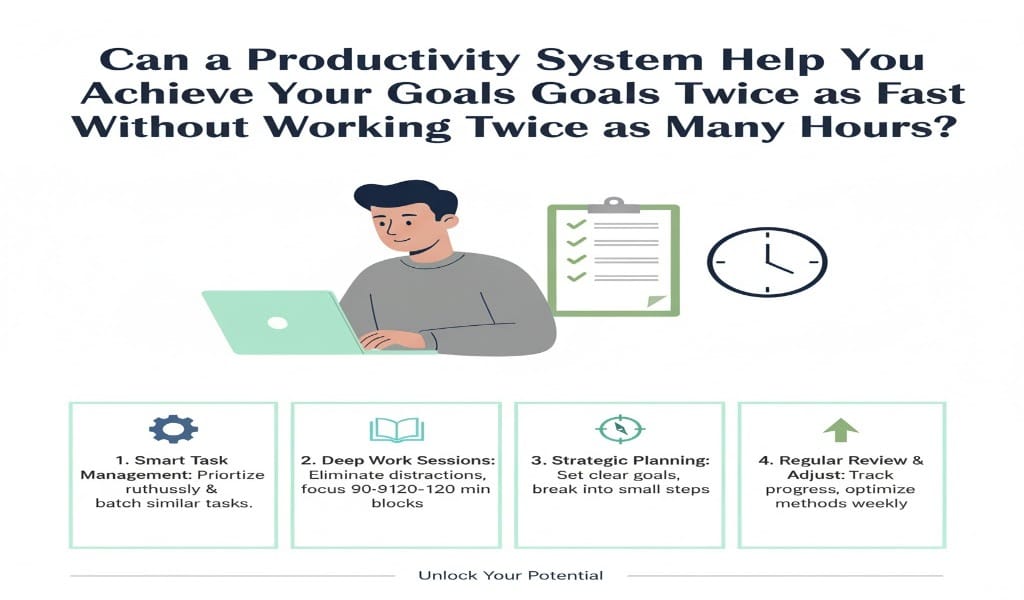
Productivity systems that actually enable goal achievement at double speed must address both success factors—choosing the right work and protecting quality attention—through four essential capabilities.
Requirement 1: Externalise Tasks and Commitments
Your brain performs poorly as a storage system. When it’s consumed with remembering dozens of commitments, little capacity remains for the strategic thinking and creative problem-solving that advance important goals.
Effective systems capture all tasks and commitments in trusted external storage. This externalisation frees mental bandwidth previously consumed by remembering, creating space for higher-value cognitive work.
The relief is immediate. The constant background anxiety about forgotten tasks diminishes. The mental energy previously spent on internal task management becomes available for focused work on important projects.
Requirement 2: Separate Planning from Execution
Most people attempt to plan and execute simultaneously, making priority decisions in the moment whilst also trying to complete work. This approach guarantees that urgency overwhelms importance.
Effective systems separate planning from execution. Dedicated planning sessions—daily and weekly—provide space for strategic thinking about priorities without the pressure of immediate execution.
During these planning sessions, you can evaluate work rationally against your actual goals rather than reacting to whatever creates the most immediate pressure. You can identify genuinely important activities and allocate time accordingly.
Then during execution sessions, you work from pre-determined priorities rather than constantly re-evaluating what deserves attention.
Requirement 3: Connect Daily Tasks to Strategic Priorities
Without explicit connection between daily activities and long-term objectives, you can stay busy indefinitely whilst making minimal progress toward important goals.
Effective systems create visible links between today’s tasks and quarterly objectives, annual goals, and long-term vision. This connection ensures that daily work actually advances strategic priorities rather than just maintaining operations.
Regular review processes maintain this alignment, adjusting daily activities as priorities shift and ensuring that effort consistently flows toward activities that matter most.
Requirement 4: Create Space for Focused deep work
Quality attention on important work requires protected time blocks free from interruption and distraction. Without this protection, even correct priority choices produce mediocre results.
Effective systems don’t just identify important work—they create the conditions necessary for your best thinking to emerge. This means scheduling uninterrupted blocks, eliminating notifications during focus time, and building workflows that batch shallow work separately from deep work.
The goal isn’t maximising hours worked but maximising the quality of attention brought to genuinely important activities.
Firefighting-to-Progress Transformation
When systems provide these four capabilities, the transformation from constant firefighting to meaningful progress happens naturally rather than requiring heroic willpower.
From Reactive to Strategic
With tasks externalised and planning separated from execution, you move from reactive response to strategic choice. Instead of working on whatever arrives in your inbox, you work on pre-determined priorities aligned with your goals.
This shift alone often doubles effectiveness. The same hours produce dramatically different results when directed strategically rather than reactively.
From Scattered to Focused
With quality attention protected for important work, you access cognitive capabilities that fragmented attention cannot reach. Complex problems get solved. Creative insights emerge. Strategic thinking improves.
A few hours of focused work on genuinely important priorities often produces more value than days of scattered attention across multiple low-priority activities.
From Busy to Effective
The compound effect of choosing the right work and bringing quality attention to it transforms productivity fundamentally. You’re no longer just busy—you’re effective at advancing objectives that matter.
This effectiveness creates a positive feedback loop. Progress on important goals generates satisfaction and motivation. Clear priorities reduce decision fatigue and anxiety. Quality work produces better results with less rework.
Sustainability Factor
Systems that enable goal achievement at double speed must also be sustainable rather than requiring unsustainable effort or creating eventual burnout.
Energy Management Over Time Management
Sustainable productivity focuses on managing energy and attention—finite resources—rather than just managing time. This means protecting your best cognitive hours for most important work, batching similar tasks to reduce switching costs, and building recovery into your schedule.
Habit-Based Execution
Relying on willpower and motivation creates unsustainable patterns. Sustainable systems build habits around planning, execution, and review that become automatic rather than requiring constant conscious effort.
Flexibility Within Structure
Life rarely follows predetermined plans. Sustainable systems provide structure for choosing and protecting important work whilst maintaining flexibility to handle unexpected issues and opportunities.
Your Progress Assessment
When was the last time you dedicated focused, uninterrupted time to something truly important but not urgent?
If you can’t remember, or if it’s been weeks since your last deep work session on strategic priorities, you’re experiencing the pattern that prevents goal achievement at any speed—much less double speed.
The gap between your current reality and double-speed goal achievement isn’t about working more hours. It’s about building systems that ensure your existing hours flow toward the right work with the right quality of attention.
This transformation doesn’t require perfection. It requires systematic improvement in how you choose work, protect attention, connect daily activities to strategic priorities, and create space for your best thinking.
The difference between constant firefighting and meaningful progress comes down to building habits and systems that protect your most valuable work—and your most creative self—from daily chaos.
Ready to build a productivity system that actually helps you achieve your goals twice as fast without working twice as many hours? The Nerd Productivity System provides the complete framework for externalising commitments, separating planning from execution, connecting daily work to strategic priorities, and protecting the focused attention that enables your best work—transforming busy ineffectiveness into focused achievement that advances what matters most in your career and life.
