
You spend two hours crafting the perfect ChatGPT prompt to analyse your quarterly goals. The AI generates impressive insights, detailed action plans, and sophisticated frameworks. You feel productive, accomplished, even enlightened by the quality of the output.
Yet at the end of the day, you realize you’ve made zero progress on the strategic project that’s been languishing for weeks. The important client conversation remains unscheduled. The difficult decision you’ve been avoiding stays unresolved.
AI created the sensation of productivity—generating substantial output and engaging in sophisticated analysis—while actually preventing you from doing the foundational work that drives real results. You’ve discovered the most sophisticated form of procrastination ever invented.
This isn’t an anti-AI argument. Artificial intelligence offers genuine productivity benefits when applied correctly. The challenge lies in understanding where AI enhances effectiveness versus where it creates elaborate distraction from essential work.
AI Productivity Paradox
AI excels at creating the feeling of productive work while potentially undermining the deep thinking and priority clarification that drives meaningful results.
Output Illusion
AI generates impressive volumes of content quickly. Detailed reports, comprehensive analyses, creative ideas, and polished communications flow effortlessly from well-crafted prompts. This output feels like progress because it resembles the deliverables of productive work.
However, output without strategic direction often becomes sophisticated busy work. The AI-generated content might be technically excellent while advancing no meaningful objectives.
Thinking Substitution Problem
AI can analyse your situation and suggest priorities, but this external analysis may prevent you from doing the internal work of clarifying what truly matters to you. When AI tells you what’s important, you miss the crucial process of discovering your own values and priorities.
This substitution becomes problematic because effective productivity requires deep personal alignment. External suggestions, however sophisticated, cannot replace the internal clarity that drives sustained motivation and good decision-making.
Complexity Amplification
AI can make poor prioritisation and lack of clarity feel sophisticated and productive. Instead of simplifying your approach, AI might generate complex frameworks that mask fundamental confusion about what matters most.
This amplification effect means that underlying productivity problems become harder to recognize and address when they’re wrapped in AI-generated sophistication.
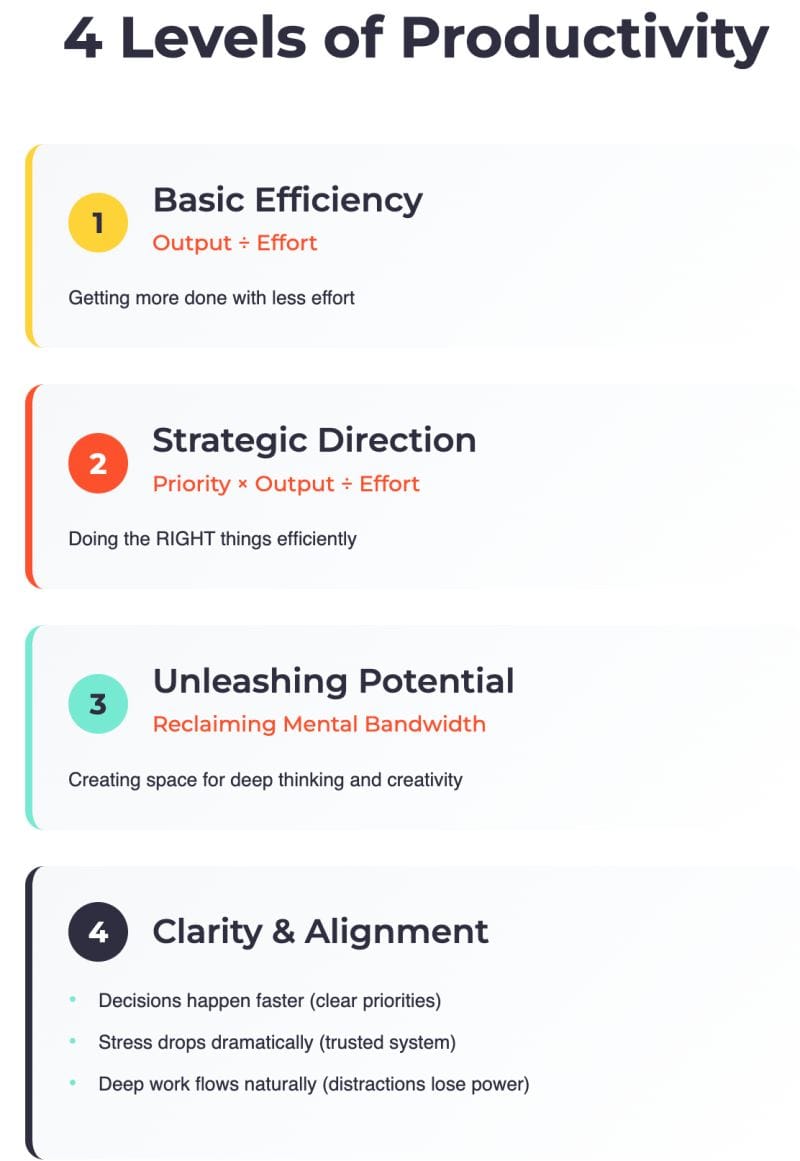
Four Levels of Productivity
Understanding AI’s proper role requires recognizing the different levels at which productivity operates. Each level presents distinct challenges and opportunities for AI enhancement.
Level 1: Basic Efficiency – Output ÷ Effort
The first level focuses on getting more done with less effort. This involves optimising processes, eliminating waste, and increasing the speed of task completion.
Traditional Approaches Basic efficiency typically involves time management techniques, automation tools, templates, and process improvements. The goal is maximising output while minimising input.
AI’s Natural Strength AI excels at Level 1 productivity. Research tasks that previously required hours can be completed in minutes. Content creation becomes dramatically faster. Data analysis that once demanded specialised skills becomes accessible to anyone.
Document review, meeting summaries, email drafting, and information synthesis all benefit from AI assistance. These applications provide immediate, measurable productivity gains that feel satisfying and concrete.
The Efficiency Trap While Level 1 improvements are valuable, they can become addictive. The immediate gratification of faster task completion may distract from higher-level productivity challenges that create more significant long-term value.
Level 2: Strategic Direction – Priority × Output ÷ Effort
The second level involves doing the right things efficiently rather than just doing things efficiently. This requires understanding which activities matter most and focusing effort accordingly.
The Priority Challenge Strategic direction depends on clear understanding of your values, goals, and trade-offs between competing opportunities. This clarity enables you to distinguish between urgent distractions and important work.
AI’s Limitation AI struggles at Level 2 because it lacks understanding of your personal values and unique situation. It can suggest general prioritisation frameworks, but it cannot make the nuanced trade-offs that effective prioritisation requires.
AI doesn’t know what success means for your specific circumstances, relationships, and long-term objectives. It cannot weigh the importance of family time versus career advancement, or determine which client relationships deserve the most attention.
The Delegation Danger When you rely on AI for priority decisions, you avoid the difficult but essential work of clarifying what matters most to you. This delegation may feel efficient in the short term but undermines your ability to make good strategic decisions independently.
Level 3: Unleashing Potential – Reclaiming Mental Bandwidth
The third level involves creating space for deep thinking, creativity, and strategic analysis by reducing the cognitive load of routine management tasks.
The Mental Bandwidth Problem When your brain is consumed with remembering tasks, managing commitments, and coordinating activities, little capacity remains for creative thinking and strategic planning. Reclaiming this bandwidth enables higher-order cognitive work.
AI as Thinking Partner At Level 3, AI excels as a thinking partner for brainstorming, exploring different angles, and challenging assumptions. It can help you think through complex problems, generate creative alternatives, and analyze situations from multiple perspectives.
AI can also handle routine cognitive tasks like information organisation, pattern recognition, and initial analysis, freeing your mind for more sophisticated thinking.
The Prerequisite Problem However, AI can only amplify mental bandwidth you’ve already reclaimed. If you’re drowning in Level 1 chaos—with disorganised commitments and unclear priorities—AI assistance just adds more noise to an already overloaded system.
Level 4: Clarity and Alignment
The fourth level involves deep alignment between your daily actions and core values, enabling decisions to happen faster, stress to drop dramatically, and deep work to flow naturally.
The Foundation Requirements Level 4 productivity requires foundational clarity about your values, priorities, and definition of success. It also requires trusted systems that externalise all commitments, freeing your mind from the anxiety of potentially forgotten tasks.
AI’s Amplification Effect AI cannot create this foundational clarity—it can only amplify whatever foundation already exists. If your foundation is solid, AI becomes a powerful tool for executing aligned priorities. If your foundation is shaky, AI amplifies the confusion.
The Trust System Challenge Achieving Level 4 requires trusting your productivity system under pressure and consistently accessing flow states. This trust develops through personal experience with reliable systems, not through external AI assistance.
Where AI Helps vs. Hurts
Understanding AI’s appropriate applications requires recognising where it enhances versus undermines different productivity levels:
AI’s Sweet Spot: Levels 1 and 3
Level 1 Enhancement AI provides immediate, measurable improvements in basic efficiency. Research, content creation, data analysis, and routine cognitive tasks all benefit from AI assistance. These applications feel satisfying because the benefits are obvious and immediate.
Level 3 Partnership AI excels as a thinking partner when you’ve already established clear priorities and organized systems. It can help you explore ideas, analyse complex situations, and generate creative solutions within the context of your established objectives.
AI’s Danger Zone: Levels 2 and 4
Level 2 Substitution AI can make poor prioritization feel sophisticated and productive. Instead of doing the hard work of clarifying your values and priorities, you might rely on AI-generated frameworks that lack personal relevance and emotional resonance.
Level 4 Foundation Erosion AI can prevent you from developing the deep personal clarity and system trust that Level 4 productivity requires. When AI handles strategic thinking, you may never develop the internal capabilities necessary for sustained high performance.
Structured Context Approach
The most effective AI integration involves using artificial intelligence as an amplifier within well-designed productivity systems rather than as a replacement for foundational work.
Foundation First
Before leveraging AI extensively, establish clear priorities, organised systems, and trusted processes for managing commitments. This foundation ensures that AI amplifies effectiveness rather than confusion.
Contextual Application
Use AI within specific, well-defined contexts rather than for general productivity guidance. AI works best when given clear parameters and specific objectives rather than open-ended productivity challenges.
Human-AI Partnership
Maintain responsibility for strategic decisions while leveraging AI for tactical execution and analysis. This partnership preserves your decision-making capabilities while benefiting from AI’s processing power.
Real-World Application Examples
Consider how AI integration works differently across productivity levels:
The Strategic Executive
Level 1: Uses AI to quickly analyse market data, summarise research reports, and draft initial communications.
Level 2: Maintains personal responsibility for priority decisions while using AI to explore implications and alternatives.
Level 3: Leverages AI as a thinking partner for strategic planning within the context of clearly defined organisational objectives.
Level 4: Uses AI to execute aligned priorities more efficiently while maintaining personal clarity about values and long-term vision.
Overwhelmed Entrepreneur
Dangerous Pattern: Relies on AI to set priorities, make strategic decisions, and provide general productivity guidance without establishing foundational clarity.
Effective Pattern: First clarifies personal values and business objectives, then uses AI to accelerate execution of clearly defined priorities.
Ambitious Professional
Level 1: Uses AI to accelerate research, content creation, and routine analysis tasks.
Level 2: Makes career decisions independently while using AI to explore potential consequences and alternatives.
Level 3: Leverages AI for creative problem-solving within the context of established career goals and personal values.
Level 4: Uses AI to enhance execution of aligned priorities while maintaining personal responsibility for life direction.
Building AI-Enhanced Productivity
Effective AI integration requires systematic development across all four productivity levels:
Phase 1: Establish Foundation
Begin with the foundational work of clarifying values, setting priorities, and organising systems. This cannot be delegated to AI—it requires personal reflection and decision-making.
Phase 2: Level 1 Integration
Start using AI for basic efficiency improvements in research, content creation, and routine analysis. These applications provide immediate benefits while you develop more sophisticated integration approaches.
Phase 3: Strategic Boundaries
Establish clear boundaries around where you will and won’t use AI for strategic decisions. Maintain personal responsibility for priority-setting while leveraging AI for tactical support.
Phase 4: Thinking Partnership
Develop AI as a thinking partner for exploring ideas and analysing complex situations within the context of your established priorities and values.
Phase 5: Continuous Refinement
Regularly evaluate whether AI is enhancing or undermining your productivity at each level. Adjust your approach based on results rather than assumptions about AI’s capabilities.
Amplifier Principle
The most effective approach treats AI as a powerful amplifier that enhances whatever foundation you’ve already established. If your foundation is solid—clear priorities, organised systems, trusted processes—AI amplifies your effectiveness dramatically.
If your foundation is weak—unclear priorities, disorganised systems, poor decision-making processes—AI amplifies the confusion and may prevent you from addressing underlying problems.
This amplifier principle explains why some people achieve remarkable productivity gains from AI while others find it creates sophisticated distraction from essential work.
Your AI Productivity Strategy
The question isn’t whether to use AI for productivity—it’s how to use AI in ways that enhance rather than undermine your effectiveness.
Start with the foundational work that only you can do: clarifying your values, setting priorities, and organising systems. This foundation ensures that AI becomes a powerful tool rather than an sophisticated form of procrastination.
Once your foundation is solid, AI can dramatically accelerate your progress toward meaningful objectives. But without this foundation, even the most sophisticated AI assistance may prevent you from doing the deep work that drives real results.
Ready to build a solid productivity foundation that enables effective AI integration? Take the Productivity Quiz to assess your current level across all four productivity dimensions and discover where foundational work will create the greatest leverage for AI-enhanced effectiveness.