
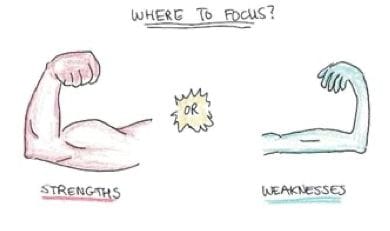
Your annual performance review arrives with the familiar refrain: “Areas for improvement.” Pages of feedback detail what you need to fix, enhance, and develop. While strengths get a brief mention, the conversation centres on closing gaps and addressing weaknesses.
This approach feels logical. After all, shouldn’t we work on our shortcomings to become well-rounded professionals?
Yet this conventional wisdom completely misses how high achievers actually create extraordinary results.
Fundamental Flaw in Traditional Performance Management
Corporate performance reviews operate on a deficit model. They assume that fixing weaknesses creates the path to exceptional performance. This assumption leads to misallocated effort and mediocre outcomes.
When ambitious professionals spend energy improving areas where they naturally struggle, they’re fighting against their core design. Time invested in weakness repair delivers minimal returns compared to strength amplification.
Consider the executive who’s brilliant at strategic thinking but struggles with detailed project management. Traditional feedback pushes them to improve their project management skills. Meanwhile, their strategic capabilities—their true differentiator—remain underutilized.
Understanding Your Personal 80/20 Formula
The 80/20 principle reveals that 20% of your efforts typically generate 80% of your results. This isn’t just about time management or task prioritizationzation. It’s deeply personal, tied to your unique combination of strengths, talents, and natural inclinations.
Your 80/20 formula differs completely from your colleague’s, even when working on identical projects. What energizes and produces results for you might drain someone else, and vice versa.
Strengths Drive Exponential Returns
Your natural talents and developed strengths represent your highest-leverage activities. When you operate in these areas, work feels effortless yet produces exceptional outcomes. Time seems to accelerate. Problems become puzzles to solve rather than obstacles to endure.
These strength zones are where multiplication happens. Small improvements in areas where you’re already strong create dramatic results. A naturally gifted communicator who sharpens their presentation skills doesn’t just get slightly better—they become magnetic.
Weaknesses Create Diminishing Returns
Your improvement areas represent the opposite dynamic. These are zones where you invest 80% of your effort for 20% of your results. Progress feels slow and requires constant energy to maintain.
Working on weaknesses might move you from poor to adequate, but rarely from adequate to exceptional. The ambitious professional who’s naturally introverted might develop decent networking skills through extensive effort, but they’ll never outperform someone who thrives on social connection.
Multiplication Effect of Strength-Based Development
Tim Ferriss captures this principle perfectly: “It is far more lucrative and fun to leverage your strengths instead of attempting to fix all the chinks in your armour. The choice is between multiplication of results using strengths or incremental improvement fixing weaknesses that will, at best, become mediocre.”
Real-World Examples of Strength Amplification
The marketing director who excels at creative strategy but struggles with data analysis shouldn’t spend months learning advanced analytics. Instead, they should partner with analytical minds while doubling down on their creative vision capabilities.
The sales professional with exceptional relationship-building skills but weak administrative habits shouldn’t invest heavily in organization systems. They should leverage assistants and automation while maximizing their time with prospects and clients.
The consultant who thinks systematically but communicates awkwardly shouldn’t focus primarily on presentation skills. They should develop frameworks and partner with natural communicators to deliver their insights.
Identifying Your Unique Strength Portfolio
Discovering your personal 80/20 requires honest self-assessment across multiple dimensions:
Natural Talents and Abilities
What comes easily to you that others find difficult? Which activities feel effortless despite producing significant results? These natural gifts often feel so automatic that you undervalue their importance.
Energy and Engagement Patterns
Which tasks energize you versus drain you? When do you lose track of time because you’re fully engaged? Your energy patterns reveal where your strengths align with your interests.
Historical Performance Data
Review your past achievements. Which accomplishments felt most natural and satisfying? What common threads connect your biggest wins? Your track record reveals your proven strength areas.
Values and Worldview Alignment
Your strengths work best when they align with your core values and perspective. The analytical thinker who values precision will excel differently than the analytical thinker who values innovation.
Transforming Organizational Performance Management
Progressive organizations are shifting from deficit-based to strength-based performance management. Instead of asking “What needs improvement?” they ask “How can we amplify what’s already working?”
Strength-Based Feedback Conversations
Effective performance discussions focus on maximizing existing capabilities rather than fixing perceived shortcomings. Managers help team members identify their unique value proposition and create opportunities to leverage their strengths more frequently.
Role Design Around Individual Strengths
Rather than forcing people into standardized job descriptions, forward-thinking teams design roles around individual strength portfolios. This approach maximizes both performance and engagement.
Complementary Team Composition
When organizations focus on strengths, they naturally build complementary teams. Instead of trying to make everyone well-rounded, they create groups where individual strengths combine to cover all necessary capabilities.
Practical Implementation for Busy Professionals
Shifting to strength-based productivity requires intentional choices about time and energy allocation:
Audit Your Current Activities
Track your tasks for one week, noting which activities align with your strengths versus weaknesses. Calculate the time percentage spent in each category.
Redesign Your Role Gradually
Look for opportunities to delegate, automate, or eliminate activities that fall outside your strength zones. Simultaneously, seek projects and responsibilities that leverage your natural capabilities.
Develop Strength-Based Partnerships
Build relationships with colleagues whose strengths complement your weaknesses. Create informal partnerships where you exchange value based on your respective capabilities.
Invest Development Time Strategically
When you do invest in skill development, focus on areas adjacent to your existing strengths rather than trying to fix fundamental weaknesses.
Productivity Transformation
When you align your efforts with your strengths, productivity stops feeling like pushing a boulder uphill. Work becomes energizing rather than draining. Results improve while effort decreases.
This shift is particularly crucial for ambitious professionals juggling multiple responsibilities. You can’t afford to waste energy on activities that don’t leverage your unique value proposition.
Your path to exceptional productivity lies not in becoming well-rounded, but in becoming exceptionally strong in your areas of natural talent and developed capability.
Ready to discover your unique productivity formula and build a system around your strengths? Take the Productivity Assessment to identify your personal 80/20 opportunities and create a customized approach that multiplies your results while reducing your effort.
