
That nagging feeling hits again. You should be working on something else. Something more important. Something urgent that you’re forgetting. The anxiety builds as you question whether you’re focusing on the right priorities.
So you check email. Then Slack. Then your task list. Then email again. Each check reveals more demands for your attention, creating additional anxiety about everything you’re not doing.
The overwhelm triggers procrastination. You scroll social media instead of tackling the complex project. You organize your desk instead of making the difficult phone call. You attend another meeting instead of working on strategic planning.
Suddenly it’s lunch time and you’ve accomplished nothing meaningful. Now you’re behind schedule, which creates pressure to work harder and longer to compensate for the lost morning.
This vicious doom loop destroys productivity and well-being for millions of ambitious professionals. The cycle feeds on itself: anxiety leads to distraction, distraction leads to procrastination, procrastination leads to more anxiety about falling behind.
Breaking this pattern requires more than time management techniques or productivity apps. You need fundamental changes to how you approach work itself.
Root Cause: Confidence Deficit
The productivity doom loop stems from a single underlying issue: lack of confidence that you’re working on the right things. When you’re uncertain about priorities, your brain creates anxiety as a motivational mechanism. Unfortunately, this anxiety becomes counterproductive, impairing your ability to focus and make good decisions.
Mental Clarity Problem
Your judgment about priorities is only as good as your mental clarity. When you’re trying to hold dozens of tasks, deadlines, and commitments in your head simultaneously, you lose the perspective necessary for strategic thinking.
Your brain becomes a unreliable task manager, randomly surfacing concerns based on anxiety rather than importance. The client email feels urgent because it’s visible. The strategic project feels less important because it’s complex and abstract.
Alignment Challenge
Even when you can think clearly about individual tasks, maintaining alignment between daily activities and long-term goals requires constant attention. Priorities shift. New opportunities emerge. Deadlines change. Without systematic realignment, you drift away from what matters most.
Many professionals work incredibly hard on activities that don’t advance their most important objectives. They’re productive in terms of task completion but ineffective in terms of meaningful progress.
Feedback Gap
Without clear feedback about which activities actually drive results, you can’t distinguish between busy work and high-impact activities. You might spend hours on tasks that feel important but don’t move the needle on your goals.
This feedback gap perpetuates ineffective work patterns. You continue investing time in low-impact activities while neglecting the 20% of work that could deliver 80% of your results.
Three-Principle Solution
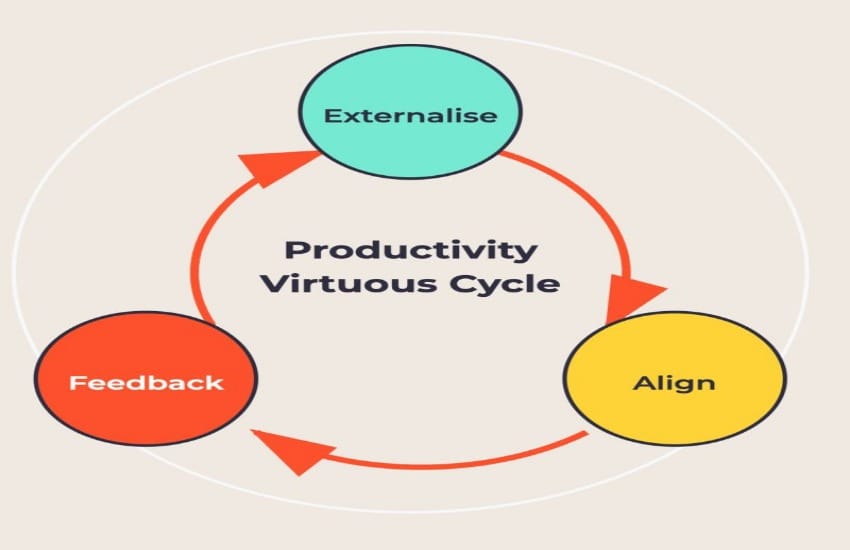
Breaking the productivity doom loop requires addressing all three underlying causes through systematic principles:
Principle 1: Externalize Everything
The first principle involves moving all tasks, commitments, and concerns out of your head into a trusted external system. This externalization serves multiple crucial functions that directly address the anxiety-distraction cycle.
Cognitive Load Reduction When your brain doesn’t have to remember everything, it can focus on thinking about what’s most important. The mental bandwidth previously consumed by memory management becomes available for strategic analysis and creative problem-solving.
Objective Perspective External systems enable objective evaluation of your commitments. When everything is visible in one place, you can see patterns, identify conflicts, and make rational priority decisions rather than reacting to whatever feels most urgent in the moment.
Trust Building A reliable external system builds trust that nothing important will be forgotten. This trust is essential for reducing the background anxiety that drives compulsive email checking and social media scrolling.
Implementation Strategy Choose one primary system for capturing all work and personal commitments. This might be a digital tool like Asana or Notion, or a combination of tools that integrate smoothly. The key is comprehensive capture—everything that requires your attention must be recorded in your trusted system.
Establish regular processing routines to organize captured items into actionable formats. Raw capture without organization simply moves the overwhelm from your brain to your tools without solving the underlying problem.
Principle 2: Align Continuously
The second principle involves regularly aligning and realigning your activities with your most important goals. This alignment process, borrowed from Agile methodology, ensures that your daily work consistently advances your strategic objectives.
Frequent Reprioritization Priorities change based on new information, shifting deadlines, and emerging opportunities. Weekly or bi-weekly reviews allow you to adjust your focus based on current reality rather than outdated assumptions.
Goal Connection Every significant activity should connect clearly to your quarterly objectives and long-term vision. If you can’t explain how a task advances your goals, question whether it deserves your time and attention.
Strategic Filtering Use your goals as filters for new requests and opportunities. When someone asks for your time or attention, evaluate the request against your established priorities before committing.
Implementation Strategy Conduct weekly reviews to assess progress on key objectives and adjust upcoming priorities. During these sessions, eliminate or delegate activities that don’t align with your goals, even if they seem important in isolation.
Create clear quarterly objectives that connect to your annual vision. Break these objectives into monthly milestones and weekly actions. This hierarchy ensures that daily tasks consistently advance long-term goals.
Principle 3: Track Feedback
The third principle involves systematically tracking which activities actually impact your desired outcomes. This feedback enables you to identify your personal 80/20 activities—the 20% of work that delivers 80% of your results.
Outcome Measurement Define clear metrics for your most important goals. Revenue growth, client satisfaction, team performance, personal development—whatever matters most should be measurable so you can track progress objectively.
Activity Analysis Regularly analyze which activities correlate with positive outcomes. You might discover that certain types of client interactions drive more revenue than others, or that specific work environments enhance your creative output.
Pattern Recognition Look for patterns in your most productive periods. What conditions, activities, and approaches consistently produce the best results? These patterns become the foundation for optimizing your approach.
Implementation Strategy Maintain a simple log of major activities and their outcomes. This doesn’t need to be detailed time tracking—just enough information to identify which approaches work best for your specific situation and goals.
Conduct monthly reviews to analyze your activity-outcome patterns. What generated the best results? What consumed time without producing value? Use these insights to adjust your approach going forward.
Real-World Application Examples
These three principles work together to create sustainable confidence and effectiveness:
Overwhelmed Executive
A senior manager feeling scattered across multiple priorities implements comprehensive capture of all commitments. Weekly alignment sessions help her focus on activities that advance her promotion goals. Monthly feedback analysis reveals that strategic thinking time produces better results than reactive meeting attendance.
Ambitious Entrepreneur
A startup founder drowning in competing demands externalizes all business and personal tasks into an organized system. Regular goal alignment helps him focus on revenue-generating activities rather than operational perfection. Tracking feedback shows that customer development conversations drive growth more effectively than product feature development.
Working Parent
A marketing director juggling career and family responsibilities captures all commitments in a trusted system. Weekly reviews help her protect time for both professional advancement and family priorities. Feedback tracking reveals that focused work blocks produce better results than fragmented task-switching throughout the day.
Compound Benefits
When you implement all three principles systematically, the benefits compound over time:
Reduced Anxiety
Trusting your system to capture everything important eliminates the background worry that drives compulsive checking behaviors. You can focus on execution rather than constantly questioning whether you’re missing something critical.
Enhanced Focus
Clear priorities and trusted systems enable sustained attention on important work. You’re not constantly interrupted by concerns about other tasks because you know they’re safely managed.
Improved Decision Making
Regular alignment and feedback create clarity about what works and what doesn’t. Decision making becomes faster and more confident because you have data about effective approaches.
Sustainable Performance
System-based productivity creates sustainable high performance rather than requiring constant willpower and stress. You can maintain effectiveness without burning out.
Beyond Individual Implementation
These principles scale beyond individual productivity to team and organizational effectiveness:
Team Application
Teams can implement shared systems for capturing commitments, regular alignment meetings for priority coordination, and feedback cycles for identifying effective collaboration patterns.
Organizational Integration
Organizations can create cultures that support externalization, alignment, and feedback rather than rewarding reactive busy work and heroic individual effort.
Leadership Modeling
Leaders who demonstrate these principles create psychological safety for their teams to focus on high-impact work rather than constantly proving their busyness.
Breaking Your Doom Loop
The productivity doom loop thrives on uncertainty and anxiety. When you don’t trust that you’re working on the right things, your brain creates stress that impairs your ability to work effectively on anything.
The three principles—externalize, align, and track feedback—create the confidence foundation necessary for sustained high performance. You know what needs to be done, why it matters, and whether your approach is working.
No amount of time management techniques, productivity hacks, or sophisticated apps can substitute for this fundamental confidence. Tools and techniques are useful, but they work best when built on a foundation of clear priorities and trusted systems.
Your path to breaking the doom loop starts with implementing these three principles systematically rather than continuing to chase productivity solutions that address symptoms rather than root causes.
Ready to build the confidence foundation that eliminates anxiety and creates sustainable productivity? The Productivity for Teams Training Program provides comprehensive frameworks and implementation support to help you and your team master these principles and create lasting effectiveness without the stress.
