
ChatGPT writes your emails in seconds. AI assistants schedule your meetings. Automated tools promise to save you hours every week. The productivity technology landscape has never been more powerful or accessible.
Yet despite these remarkable capabilities, many ambitious professionals feel more overwhelmed than ever. They’re drowning in notifications, struggling with competing priorities, and working longer hours while accomplishing less meaningful work.
The promise of AI productivity gains feels hollow when your fundamental approach to work remains chaotic and reactive.
AI Productivity Illusion
Artificial intelligence excels at specific, well-defined tasks. It can draft emails, summarize documents, generate ideas, and automate routine processes. These capabilities provide genuine value when applied correctly.
However, AI amplifies your existing patterns rather than fixing underlying dysfunction. If you’re already scattered, reactive, and overwhelmed, AI tools will help you be scattered, reactive, and overwhelmed more efficiently.
Speed Without Direction Creates Chaos
AI enables you to produce content faster, respond to messages quicker, and process information more rapidly. But speed without clear direction often leads to more work rather than better outcomes.
The executive who uses AI to respond to every email immediately creates an expectation of constant availability. The consultant who generates content rapidly without strategic focus produces volume without impact. The manager who automates task creation generates more items for an already overflowing to-do list.
Technology Can’t Solve Human Psychology
The deepest productivity challenges aren’t technical—they’re psychological and behavioral. Anxiety about missing important tasks. Overwhelm from competing priorities. Procrastination on difficult but important work. Distraction from constant digital interruptions.
AI tools can’t address the emotional states that drive unproductive behaviors. They can’t help you identify what truly matters or give you the courage to say no to good opportunities that don’t align with your priorities.
Foundation of Real Productivity
Sustainable productivity improvements require addressing fundamental mental models and emotional patterns before layering on technological solutions.
Mental Models: How You Think About Work
Your mental models shape how you approach tasks, make decisions, and allocate attention. Without clear frameworks for organizing work and making priority decisions, even the most sophisticated tools become sources of additional complexity.
Capture and Organization Systems
Do you externalize all commitments into a trusted system, or does your brain constantly worry about forgotten tasks? Mental clutter prevents clear thinking and strategic focus.
Priority Frameworks
Can you quickly distinguish between urgent distractions and important work? Without clear criteria for making trade-off decisions, you’ll remain reactive regardless of your tool stack.
Goal Alignment Processes
Do you regularly review whether your daily activities support your long-term objectives? Disconnection between daily tasks and meaningful goals creates busy work rather than progress.
Emotional States: How You Feel About Work
Your emotional relationship with work dramatically impacts productivity. Anxiety, overwhelm, and procrastination create internal resistance that no external tool can overcome.
Anxiety and Mental Load
When your brain carries the burden of remembering everything, anxiety increases and focus decreases. Trusted external systems reduce mental load and create space for deep thinking.
Overwhelm and Decision Fatigue
Too many choices and competing priorities exhaust your decision-making capacity. Clear frameworks and boundaries preserve mental energy for important decisions.
Procrastination and Avoidance
Difficult or ambiguous tasks trigger avoidance behaviors. Breaking complex work into clear, manageable steps reduces resistance and increases momentum.
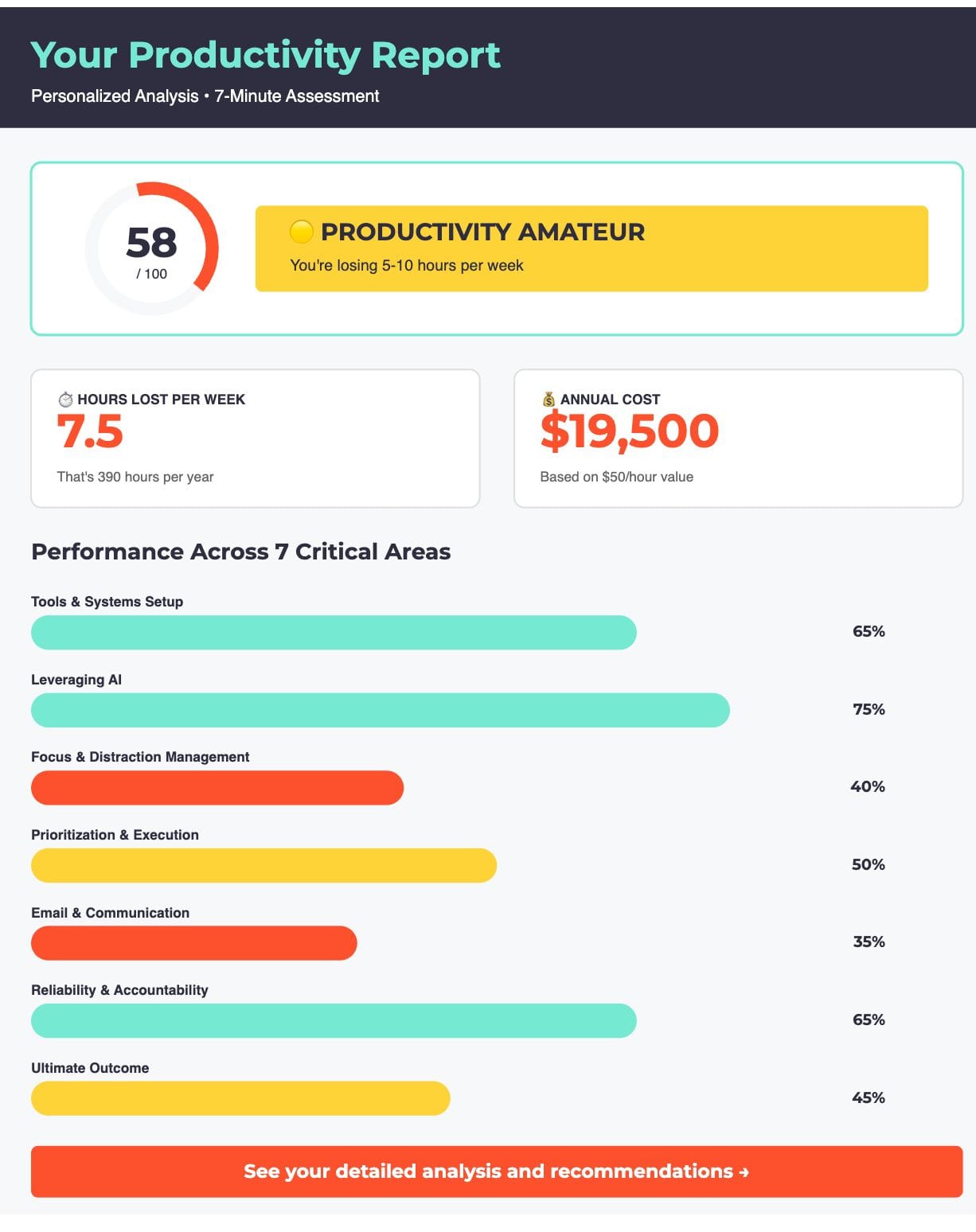
Seven Critical Areas of Productivity Effectiveness
Real productivity improvement requires systematic attention to multiple interconnected areas:
1. Tools and Systems Setup
Your productivity infrastructure should reduce friction rather than create it. Integrated tools that work together seamlessly support focused work. Fragmented systems that require constant maintenance become productivity drains.
2. Leveraging AI Appropriately
AI works best when applied to well-defined, routine tasks within organized workflows. Random AI experimentation often creates more complexity than value.
3. Focus and Distraction Management
The ability to sustain attention on important work distinguishes high performers from busy underachievers. This requires both environmental design and internal discipline.
4. Prioritization and Execution
Clear frameworks for identifying what matters most and systematic approaches for making progress on priorities prevent reactive busy work.
5. Email and Communication Management
Proactive communication strategies prevent constant interruption while maintaining responsiveness to important requests.
6. Reliability and Accountability
Systems that ensure commitments are met and deadlines are honored build trust and reduce stress for both you and your colleagues.
7. Goal Achievement Processes
Regular alignment between daily activities and long-term objectives ensures your productivity efforts drive meaningful progress.
Building Productivity on Solid Foundations
Effective productivity transformation follows a specific sequence:
Phase 1: Establish Mental Models
Begin by developing clear frameworks for organizing work, making decisions, and managing attention. These mental models provide the foundation for all subsequent improvements.
Phase 2: Address Emotional Patterns
Identify and resolve the anxiety, overwhelm, and procrastination patterns that create internal resistance to productive work.
Phase 3: Design Supporting Systems
Create tools and workflows that support your mental models and emotional well-being rather than fighting against them.
Phase 4: Integrate AI Strategically
Layer artificial intelligence capabilities onto your solid foundation to amplify effectiveness rather than complexity.
Compound Effect of Systematic Improvement
When you address productivity systematically rather than chasing individual hacks or tools, improvements compound over time. Better mental models lead to clearer decisions. Reduced anxiety enables deeper focus. Organized systems create space for strategic thinking.
The ambitious professional who masters these fundamentals doesn’t just work faster—they work on more meaningful projects with greater impact and less stress.
Sustainable High Performance
System-based productivity creates sustainable high performance rather than requiring constant willpower and energy. You can maintain effectiveness across multiple life domains without burning out.
Strategic Thinking Capacity
When routine management becomes automatic, your brain has space for creative and strategic thinking. You can focus on opportunities and innovations rather than just keeping up with demands.
Work-Life Integration
Effective productivity systems enable better boundaries between work and personal life. You can be fully present with family because work systems manage professional responsibilities reliably.
Measuring Your Current Reality
Before implementing new tools or techniques, assess your current productivity effectiveness honestly. Understanding your specific strengths and weaknesses enables targeted improvement rather than generic solutions.
Consider these diagnostic questions:
Do you trust your system to capture and organise all commitments? Can you quickly identify your highest priorities? Do you protect time for deep work on important projects? Are you reactive to communications or proactive in managing them?
Your answers reveal where focused attention will generate the greatest productivity improvements.
Ready to discover your specific productivity strengths and weaknesses?
Take the comprehensive Productivity Assessment to get your personalized productivity score across seven critical areas, plus a customized recovery plan to reclaim 5-15 hours per week starting immediately.
