
The CEO storms into the Monday morning meeting with fire in his eyes. “I don’t care how you get it done, just get it done. We need those numbers by Friday.” His team productivity exchanges glances, knowing they’re about to enter another week of 12-hour days, frantic coordination, and stressed-out execution.
Down the hall, another CEO starts her team meeting differently: “Let’s talk about how we can redesign this process to deliver better results with less stress on everyone.” Her team leans in, energized by the opportunity to improve both their work and their outcomes.
Both leaders face similar challenges and pressure to deliver results. Yet their approaches create dramatically different outcomes—not just in team morale, but in actual business performance.
After working with dozens of CEOs and senior leaders across various industries, a clear pattern emerges. Leaders consistently fall into one of two distinct categories, and the difference between them determines not just workplace culture, but fundamental business success.
Two Leadership Archetypes
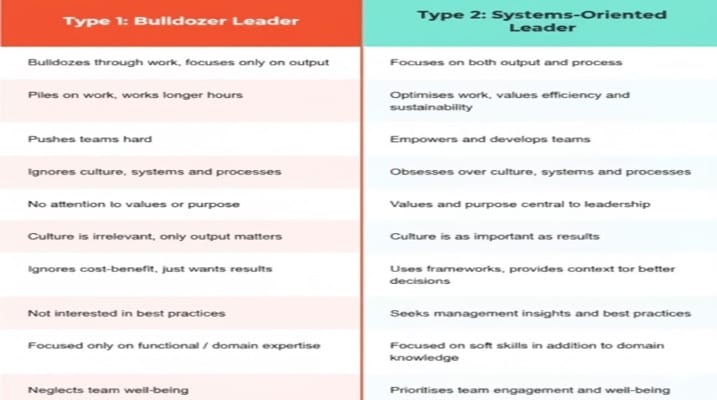
Every leader, regardless of industry or company size, operates according to one of two fundamental philosophies about how work gets done.
Type 1: The Bulldozer Leader
Bulldozer leaders focus exclusively on output. They believe that results come from effort, and more effort always produces better results. When faced with challenges, their instinctive response is to apply more force—longer hours, additional people, increased pressure.
The Output-Only Mindset These leaders measure success purely by deliverables. If a task takes 2 hours or 12 hours doesn’t matter—what matters is completion. They view efficiency discussions as distractions from the real work of producing results.
The Resource Multiplication Approach When problems arise, bulldozer leaders throw resources at them. Missed deadline? Add more people. Quality issues? Work longer hours. Team stress? Push harder because pressure creates diamonds.
The Process Dismissal Systems, processes, and methodologies feel like bureaucratic overhead to bulldozer leaders. They prefer direct action over systematic approaches, believing that analysis and optimization waste time that could be spent on execution.
The Culture Afterthought Team morale and workplace culture rank low on the priority list. These leaders often believe that good results automatically create good culture, and that focusing on employee satisfaction distracts from performance.
Type 2: The Systems Leader
Systems leaders obsess over how things get done as much as what gets done. They understand that sustainable results come from sustainable processes, and that the method determines both the outcome and the cost of achieving it.
The Process-Focused Mindset These leaders view processes as force multipliers. They invest time in understanding how work flows, where bottlenecks occur, and how systems can be optimized to produce better results with less effort.
The Efficiency Obsession Systems leaders constantly ask: “How can we achieve the same result with less stress, fewer resources, and higher quality?” They see efficiency not as cutting corners, but as maximizing value creation.
The Framework Orientation Rather than making decisions reactively, systems leaders develop frameworks and principles that guide consistent decision-making. They study management best practices and adapt proven methodologies to their specific contexts.
The Culture Investment These leaders understand that culture is a competitive advantage. They invest in creating environments where people can do their best work, knowing that engaged teams consistently outperform stressed teams.
Performance Reality
While both approaches can produce short-term results, the long-term performance differences are dramatic and measurable.
McKinsey Management Research
McKinsey & Company’s extensive research on management practices reveals a stunning performance gap. Organizations in the top 25% for management practices deliver 21 times higher average returns than those in the bottom quartile.
This isn’t a small difference—it’s a fundamental performance chasm that separates truly successful organizations from those that merely survive.
Sustainability Factor
Bulldozer approaches often produce impressive short-term results that mask underlying problems. Teams can work unsustainable hours for weeks or months, but eventually performance degrades due to burnout, turnover, and accumulated stress.
Systems approaches may appear slower initially but create compound benefits over time. Efficient processes, engaged teams, and optimized workflows generate consistent performance that improves rather than degrades over time.
Innovation Differential
Bulldozer cultures rarely produce breakthrough innovations because everyone is too busy executing to think strategically. The constant pressure to deliver immediate results crowds out the reflection and experimentation necessary for creative solutions.
Systems cultures create space for innovation by handling routine work efficiently, freeing mental bandwidth for creative problem-solving and strategic thinking.
Hidden Costs of Bulldozing
While bulldozer leadership may feel more decisive and action-oriented, it creates hidden costs that compound over time:
Talent Drain
High-performing individuals eventually leave bulldozer organizations because they prefer environments where their capabilities are leveraged intelligently rather than just intensively. The constant turnover creates recruitment costs and knowledge loss.
Quality Degradation
When speed and volume matter more than method, quality inevitably suffers. Rushed work requires rework, creating cycles of inefficiency that consume more resources than careful initial execution.
Strategic Blindness
Bulldozer leaders become so focused on immediate execution that they miss strategic opportunities and threats. They’re fighting today’s battles while competitors are preparing for tomorrow’s wars.
Organizational Fragility
Systems built on heroic individual effort rather than robust processes become fragile. When key people leave or become unavailable, entire operations can collapse because knowledge and capabilities weren’t systematized.
Systems Leadership Advantage
Systems leaders create compound advantages that accelerate over time:
Scalable Excellence
Well-designed systems enable consistent high performance regardless of individual variations. New team members can quickly achieve excellence because the methods are documented and optimized.
Adaptive Capacity
Organizations with strong systems can adapt more quickly to changing conditions because they understand how their processes work and can modify them systematically.
Talent Multiplication
Systems leaders develop their people by creating environments where individual capabilities are amplified through good processes and clear frameworks. This investment pays dividends through improved performance and retention.
Sustainable Growth
Growth built on systematic foundations can be sustained and replicated. Systems leaders can scale their organizations without proportional increases in stress and complexity.
Real-World Applications
Consider how these two approaches play out in common business scenarios:
Product Launch Scenario
Bulldozer Approach: “We need to launch in 8 weeks. Everyone work weekends until it’s done. Figure out the details as we go.”
Systems Approach: “Let’s map out the launch process, identify potential bottlenecks, and create contingency plans. We’ll establish clear milestones and communication protocols to ensure quality delivery.”
Crisis Management
Bulldozer Approach: “All hands on deck. Cancel everything else until this is fixed. Work around the clock if necessary.”
Systems Approach: “Let’s analyze what caused this issue, implement immediate fixes, and create processes to prevent recurrence. We’ll establish clear roles and communication protocols for crisis response.”
Team Performance Issues
Bulldozer Approach: “Performance is down. Everyone needs to work harder and stay later until numbers improve.”
Systems Approach: “Let’s understand what’s causing performance issues. Are there process bottlenecks, resource constraints, or skill gaps we need to address?”
Growth Challenges
Bulldozer Approach: “Revenue needs to double. Everyone just needs to do more—more calls, more meetings, more everything.”
Systems Approach: “Let’s analyze our current processes to identify the highest-leverage growth activities and optimize our approach before scaling effort.”
Building Systems Leadership Capabilities
Transitioning from bulldozer to systems leadership requires developing specific capabilities and mindsets:
Process Thinking
Learn to see work as systems rather than individual tasks. Understand how activities connect, where bottlenecks occur, and how improvements in one area affect others.
Framework Development
Create decision-making frameworks that enable consistent, high-quality choices without requiring constant leadership involvement. This scales your judgment across the organization.
Measurement Systems
Develop metrics that track both outcomes and process health. Monitor not just what gets delivered, but how efficiently and sustainably it gets delivered.
Culture Investment
Treat culture as a strategic asset that requires intentional development. Create environments where people can do their best work rather than just demanding better results.
Long-term Perspective
Balance short-term delivery pressure with long-term capability building. Invest in systems and processes that create compound benefits over time.
Leadership Choice
Every leader faces a fundamental choice: focus exclusively on immediate results or invest in the systems that create sustainable results.
This choice affects not just business performance, but team satisfaction, personal sustainability, and long-term competitive advantage.
Compound Effect
Systems leadership creates compound benefits that accelerate over time. Initial investments in processes and culture pay dividends through improved efficiency, higher quality, and better team performance.
Sleep Factor
Systems leaders often report better work-life balance and less stress because they’re not constantly firefighting. Good systems handle routine challenges automatically, freeing leaders to focus on strategic opportunities.
Legacy Impact
Bulldozer leaders may achieve impressive short-term results, but systems leaders build organizations that outlast their tenure. They create capabilities and cultures that continue generating value long after they move on.
Your Leadership Assessment
Which type of leader are you becoming? Consider these diagnostic questions:
- When facing challenges, do you instinctively add resources or optimize processes?
- Do you measure success purely by output or also by efficiency and sustainability?
- Do you view process discussions as valuable strategy or bureaucratic overhead?
- Do you invest in culture and team development or focus exclusively on deliverables?
- Do you make decisions reactively or use systematic frameworks?
Your answers reveal whether you’re building a bulldozer or systems approach to leadership.
Performance Imperative
The data is clear: systems leadership doesn’t just create better workplaces—it delivers superior business results. The 21x performance advantage isn’t a small edge; it’s a fundamental competitive advantage that determines long-term success.
In an increasingly complex and competitive business environment, the leaders who survive and thrive will be those who master the art of systematic excellence rather than heroic effort.
The choice isn’t between caring about results or caring about people—it’s between achieving results through unsustainable force or sustainable systems.
Your leadership approach determines not just your team’s experience, but your organization’s ultimate success.
Ready to assess whether your team is operating with bulldozer intensity or systems efficiency? Take the Team Productivity Assessment to discover where systematic improvements could multiply your results while reducing stress and creating a more sustainable path to excellence.