
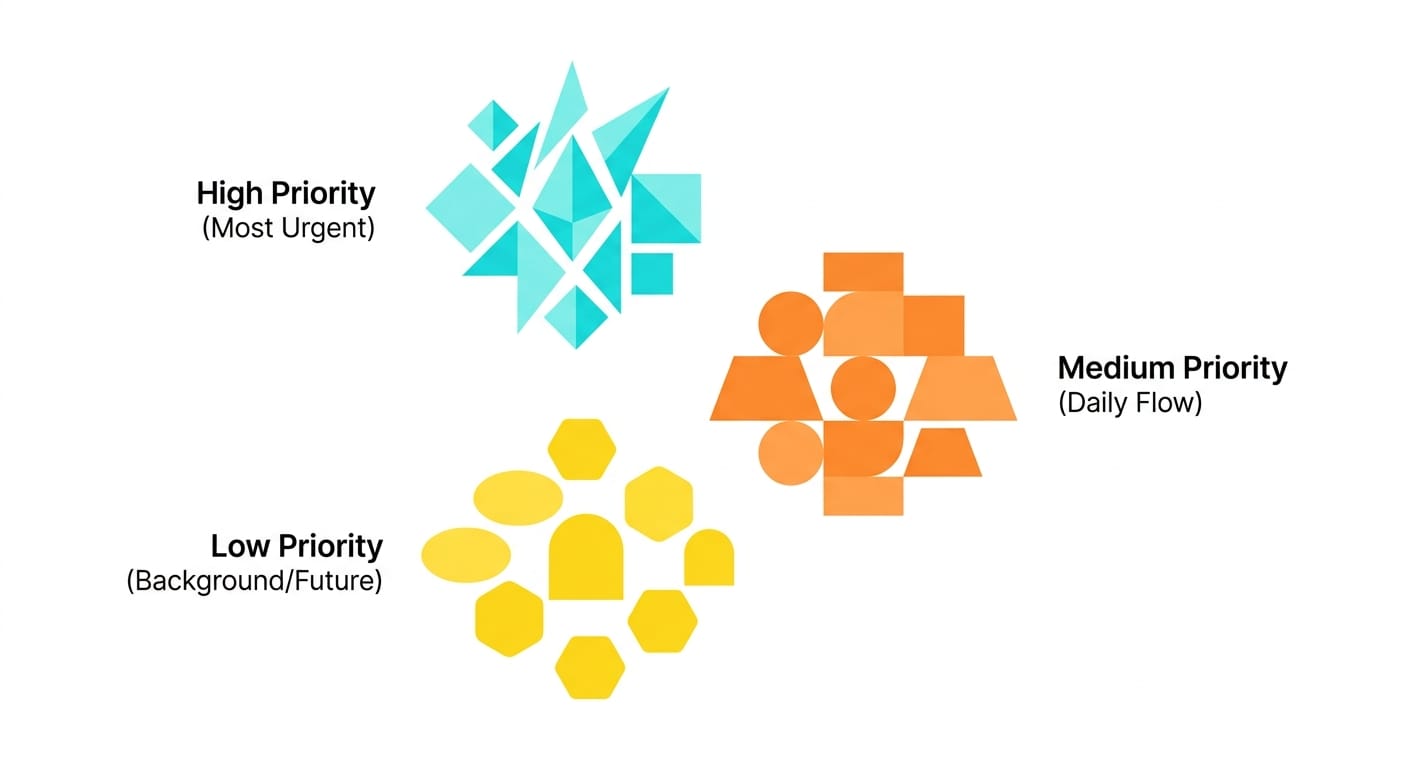
Oliver Burkeman’s 333 technique is a daily planning method built on an unfashionable idea: that the task is not to do more, but to choose well what you do at all. The method divides a working day into three categories — three hours on one important project, three shorter tasks that genuinely need to happen today, and three maintenance activities that keep your week from falling apart. Burkeman, a British journalist and author of Four Thousand Weeks: Time Management for Mortals, arrived at this structure not through time-and-motion research but through philosophy: the recognition that a finite life produces a permanently overfull to-do list, and that the only sane response is deliberate limitation.
If you want the full practical walkthrough of the method, the main 3-3-3 rule post covers every setup step. This piece goes one level deeper: where the technique came from, why Burkeman chose the number three, and how his underlying philosophy changes the way you apply it.
Where the 333 technique comes from
Burkeman has spent his career writing about the psychology of time. His 2021 book, Four Thousand Weeks, opens with a calculation: a human life of eighty years is roughly four thousand weeks. His argument is that productivity culture is largely a collective refusal to face this arithmetic. The more efficient you become, the more you take on, and the more you feel behind. The goal of doing everything is not just unrealistic — according to Burkeman, it is the source of the anxiety, not the relief from it.
The 333 technique is a direct expression of that argument. By capping your day at three outputs in each category, it forces a decision about what not to do. The limit is not a concession to a bad day — it is the system. Burkeman writes about what he calls fixed scheduling: protecting a set number of hours and tasks before the day begins, accepting that anything beyond that list must wait or be dropped.
He developed these daily practices further in his 2024 follow-up, Meditations for Mortals, which builds a practical philosophy for people who have accepted the limits he describes in Four Thousand Weeks. The 333 technique sits squarely in this tradition: a concrete daily structure built on the acceptance that you will never be finished, so the only real question is what you do first.
What the three layers actually mean
The 333 technique has three layers, and each carries its own logic.
Three hours on one project. Not three hours split across your inbox, your Slack, and a client call. Three hours on the single piece of work that would matter most if you looked back at the year. Burkeman’s framing here aligns with Cal Newport’s research on deep work: cognitive output compounds when attention is sustained, not when it is parcelled across a queue. The three-hour block is not a stretch goal — research consistently shows it is close to the upper limit of useful sustained focus for most knowledge workers.
Three urgent tasks. These are legitimate urgencies — the things that cannot wait until tomorrow without a real consequence. They are not the things that feel urgent because they arrived this morning. Burkeman is explicit about this distinction: most of what feels urgent is not urgent, it is merely new. Three slots is the test. If you have six urgent tasks and only three slots, at least three of them are either not urgent, should be delegated, or should be dropped.
Three maintenance items. These are the small acts that prevent entropy: clearing email, tidying a workspace, a ten-minute conversation that has been deferred. They are not important enough for the deep work block and not urgent enough for the second tier. Their function is to stop the background layer of life accumulating into a crisis. Three of them, not eight.
Why Burkeman chose three
The number three is not arbitrary. Burkeman’s choice reflects two constraints working at the same time.
The first is cognitive. Working memory holds roughly three to four items comfortably; beyond that, the friction of switching between tasks rises faster than output does. Three urgent tasks is not a productivity-influencer simplification — it matches how attention actually works under pressure.
The second constraint is philosophical, and it is the part that most time management advice ignores. Choosing three forces you to name what you are not doing. A list of six urgent tasks allows you to tell yourself that everything matters and that you are trying. A list of three means deciding explicitly that the fourth item waits. That decision, made in advance and in writing, is what Burkeman means by taking responsibility for your finite time.
Most prioritisation methods tell you how to rank your tasks. The 333 technique tells you how many you are allowed. That distinction matters more than it first appears.
How this differs from standard time management
Conventional time management aims to increase output by reducing waste. GTD lists every action across every project. Time-blocking schedules tasks into calendar slots. The 80/20 rule identifies the highest-value work. All of these assume that the goal is to do more, and that the method helps you get there faster.
Burkeman’s technique makes a different assumption: the goal is not to do more, but to do the right things well and accept that everything else waits. His method is not optimisation — it is selection. In practice, this produces a different psychological experience. Rather than ending a day feeling behind on a long list, you end it having completed what you decided mattered, and having made a clear decision that everything else was less important today.
That difference matters particularly for business owners. If you run a company, your to-do list is structurally unlimited. Clients, staff, operations, strategy, and family all compete for the same cognitive budget. A method that promises to help you do everything faster simply moves the overwhelm around. A method that says “name three things, decide the rest can wait” resolves the overwhelm by taking the decision seriously rather than deferring it.
The two common failure modes
The technique has two predictable failure points.
The first is treating the three hours as available time rather than protected time. Three hours on the calendar that other people can book over is not three hours — it is a wish. The block has to be defended: moved to a slot where meetings cannot land, repeated as a recurring hold, and explained to anyone who tries to book across it.
The second is that the six urgent tasks on the real list do not shrink to three just because the method says three. They have to be actively killed, pushed, or delegated. Burkeman is direct about this: choosing three means choosing not to do the other four. That act of not-doing is not a failure of the method — it is the method working correctly.
How the 333 technique connects to the NP System
In the Nerd Productivity System, the 333 technique sits inside the Do phase. The Capture, Process, and Plan phases do the upstream work: everything is collected, triaged, and ranked before the day begins. The 333 technique is where that upstream work pays off — it gives you a daily allocation mechanism that is already working with pre-ranked inputs, rather than trying to prioritise under pressure at 9am.
The connection to Rocks and MITs is direct: the weekly Rock is the project that earns the daily three hours. The MITs (Most Important Tasks) map onto the three urgent slots. The maintenance tier handles the open-loop tasks that GTD calls next actions. The systems have different origins but compatible structures — Burkeman’s daily layer sits cleanly on top of the NP System’s weekly layer.
If you want to build this into your own week, the entrepreneur daily schedule guide walks through how to wire the time blocks into a real calendar. The free NP System course covers the full framework behind it.
Frequently asked questions
What is Oliver Burkeman’s 333 technique?
Oliver Burkeman’s 333 technique is a daily planning method that limits each workday to three categories: three hours of focused work on one important project, three shorter urgent tasks, and three maintenance activities. Burkeman, author of Four Thousand Weeks, built the method around the idea that a finite life demands deliberate limitation rather than optimisation — choosing what not to do is the core skill, not doing more things faster.
Where did Oliver Burkeman describe the 333 method?
Burkeman has written about fixed scheduling and deliberate limitation across his books Four Thousand Weeks (2021) and Meditations for Mortals (2024), and in his Substack newsletter The Imperfectionist. The 333 framing draws directly from his argument that choosing what not to do is the central challenge of time management, not efficiency.
How does the 333 technique differ from time-blocking?
Time-blocking is a scheduling technique that assigns tasks to specific calendar slots. The 333 technique is a selection method that limits how many items are eligible for the day at all. The two work well together: the 333 technique decides what makes the list, and time-blocking decides when each item happens. Burkeman’s contribution is the selection step, which most time-blocking frameworks skip.
What if my urgent tasks take more than an hour each?
If a task consistently takes more than an hour, it is likely a project rather than a task, and belongs in the deep work block rather than the urgent tier. Break it into its smallest executable next action — the one step that moves it forward today — and put that in the urgent slot instead. The three-slot limit is what forces this breakdown to happen.
Does the 333 technique work if you manage a team?
Yes, but the maintenance tier shifts. For managers, maintenance often includes brief check-ins and decision points that keep other people unblocked. These still belong in the third tier — short, not urgent, but important for the week’s momentum — and the three-slot limit still applies. The deep work block protects the strategic work that only you can do.
