
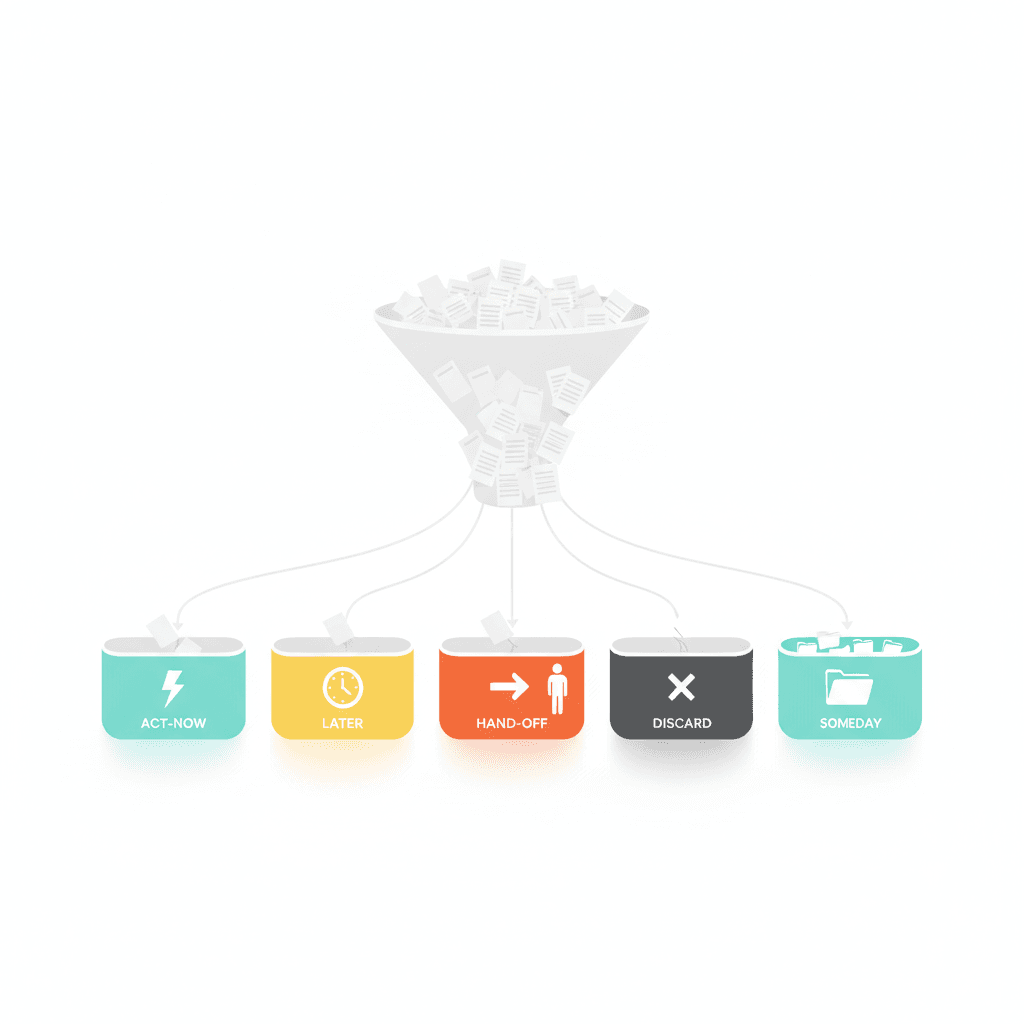
The 5 Ds of productivity is a five-decision triage applied to every task that crosses your desk: Do it, Defer it, Delegate it, Drop it, or Diary it. The rule is that no task gets to sit unprocessed — it earns one of the five Ds within ninety seconds of arriving in your queue. After two weeks of practice, the framework collapses an inbox of 600 items into a manageable 30, and the rest of the work day stops feeling like a defensive crouch against the next email.
I’ve been teaching this triage for ten years across founders, partners, COOs, and senior managers. It’s the single most useful idea in the Nerd Productivity System for anyone who feels permanently behind on email or task list. It works because it removes the most expensive cost in productivity — the cost of touching a task twice without making a decision.
The five decisions
Each new task arrives at your inbox or notes app. You read it once. You then choose exactly one of these five actions.
Do
The task takes less than two minutes to complete. Do it now. Don’t move it onto a list, don’t schedule it, don’t think about it. Just do it. The rule comes from David Allen’s Getting Things Done: anything that fits inside the two-minute window costs more in admin to process than to execute. Examples: a quick yes/no email reply, a single approval, a calendar acceptance.
Defer
The task takes more than two minutes and only you can do it. Move it onto your task list with a date and a context. The defer step is where most people fail because they defer to “soon” or “this week” rather than to a specific day. Soon is not a date. Defer to Tuesday at 9am or to next Monday’s batch — somewhere a future version of you will see it and act.
Delegate
The task takes more than two minutes and someone else can do it. Hand it off, with one paragraph of context and a deadline. The delegation rule is that you forward the task before you forget it; if it sits in your inbox waiting to be delegated, you’ve already failed the test. Most undelegated work is the result of “I’ll send this to Sarah after the meeting” — and then you don’t.
Drop
The task doesn’t deserve to be done. By you, by anyone, ever. Delete it. Most knowledge workers significantly underuse this option because dropping a task feels like failure. It isn’t. The drop is the cleanest of the five Ds because it removes a future cost permanently. About 30 percent of inbox items in a typical executive’s queue should be dropped on first read; most people drop closer to 5 percent.
Diary
The task isn’t actionable now but might be later. Move it to a “someday/maybe” list with a review date. The diary is your hedge against false dropping — a place where ideas that aren’t ready can age until the timing is right or you can confirm-drop them six months from now. Without the diary, every borderline item gets either dropped (and lost) or deferred (and clogs the system).
That’s the entire framework. Five decisions. No sixth option.
Why the system works
The 5 Ds works because it forces a decision in the moment of contact. The expensive part of email or task management isn’t doing the tasks — it’s the half-decisions where you read an item, register it as “something to deal with,” and then leave it sitting. Each unprocessed item costs you cognitive load every time you see it again. A 600-item inbox isn’t 600 tasks of work; it’s 600 mini-decisions you’ve already deferred, looping in the background.
The five Ds collapse that loop. Each item is processed once, fully. Reading it AND deciding it are the same act. Within two weeks of running the framework consistently, your inbox starts to clear permanently — not because you’re doing more work, but because you’re doing less re-reading.
The other reason it works: each D maps to a different cognitive system. Do uses execution. Defer uses scheduling. Delegate uses interpersonal trust. Drop uses judgment. Diary uses pattern memory. By assigning each item to one system, you keep all five running at once instead of letting any single one bottleneck the others.
How to actually use it
The setup is one rule and a daily session.
The rule: every new task gets one of the five Ds within ninety seconds of you reading it. No exceptions. Set a timer if you have to. The ninety seconds is what stops you from re-reading.
The session: five to fifteen minutes a day, ideally in the morning, processing your inbox using the framework. Open each item, decide its D, act on the D (if it’s Do, do it; if it’s Defer, schedule it now; if it’s Delegate, send the email now; if it’s Drop, delete; if it’s Diary, file it). Move to the next item. Don’t re-open processed items.
The first two days are slow. You’ll fight the urge to “deal with this later.” By day three the muscle starts forming and the inbox actually empties. By week two, the system runs in twelve minutes per morning instead of forty.
Common failure modes and how to fix them
Most things end up Deferred. This is the most common pattern and it usually means you’re not using Drop and Delegate enough. Audit your last week’s defer list: how many of those items, in retrospect, should have been dropped? How many should have gone to your team or assistant? If the answer is “a lot,” you’re using Defer as a stalling tactic.
The diary becomes a graveyard. If your “someday/maybe” list has hundreds of items and you never review it, it’s not functioning as a diary — it’s where dead tasks go to hide. Review the diary weekly, in five minutes, and Drop everything that’s no longer relevant. The diary is supposed to feel manageable.
Drop feels reckless. This is psychological more than tactical. Try this experiment: drop ten things in a row, then track over the next month whether any of them came back to bite you. Almost none will. The fear of dropping is much larger than the actual cost.
Two-minute rule expands. “This is just a quick reply, two minutes” turns into eight minutes of crafting a perfect response. Set an actual two-minute timer for the first month. If the task isn’t done at two minutes, stop and Defer it.
How the 5 Ds connects to the rest of the system
The 5 Ds is one component of the Process phase in the Nerd Productivity System. The full sequence is Capture, Process, Plan, Do — and the 5 Ds is the engine inside Process. It runs every time something new arrives and demands a decision.
It pairs with:
- Universal capture (the Capture phase): every new thought or task lands in a single inbox, ready for the 5 Ds to triage.
- Time-blocking and the 3-3-3 rule (the Do phase): items that come out of the 5 Ds as “Do” or “Defer” with a date end up scheduled into time blocks for execution.
- The weekly review: the Diary list is reviewed weekly to drop or promote items.
Without the 5 Ds, the rest of the system can’t function — Capture floods Plan with un-triaged items. With the 5 Ds, the system stays clean week after week.
A worked example
Tuesday, 8:00am. Inbox: 23 new items since Monday evening.
- Email from accountant: VAT filing deadline confirmation — Do (15 seconds: read, mark as filed, archive).
- Slack notification: vendor follow-up — Defer to Thursday 10am (vendor calls batch).
- Newsletter — productivity tools roundup — Drop (delete; not relevant to current work).
- Email from Sarah on team: client pricing question — Delegate back to Sarah with one-line context, deadline EOD.
- Idea note from yesterday: product feature concept — Diary (move to someday/maybe, weekly-review tag).
- Calendar invite for Friday — Do (accept, 5 seconds).
- Another idea note: rewrite homepage hero — Diary.
- Email from procurement: quote needed — Defer to Wednesday 2pm (procurement batch).
…and so on through the 23 items. By 8:12am, the inbox is at zero. Three “Do” items completed. Six items deferred to specific times this week. Two delegated. Eight dropped. Four in the diary.
The day starts with a clean inbox and a calendar that holds every commitment. By Friday, the same pattern has repeated five times. There is no inbox to “catch up on” because there’s never an inbox in the first place.
Frequently asked questions
What are the 5 Ds of productivity?
The 5 Ds are Do, Defer, Delegate, Drop, and Diary. Each task that crosses your desk earns exactly one of these five decisions within ninety seconds of being read. Do means take action immediately if it’s under two minutes. Defer means schedule for a specific day if only you can do it. Delegate means hand it off to someone else with deadline and context. Drop means delete because the task doesn’t deserve to exist. Diary means file in a someday/maybe list for later review.
Where does the 5 Ds framework come from?
The two-minute rule (Do) and the do/defer/delegate distinction come from David Allen’s Getting Things Done. The Drop and Diary additions are part of the Nerd Productivity System, refined across ten years of working with founders and senior executives. The full five-decision framework collapses inbox triage into a single repeatable habit.
How long does it take to run the 5 Ds on an inbox?
After two weeks of practice, twelve to fifteen minutes for an inbox of forty items. The first few days are slower because the muscle hasn’t formed; expect thirty to forty-five minutes initially. Within a fortnight, the per-item time drops below thirty seconds and the system steady-states.
What’s the difference between Defer and Diary?
Defer items have a specific date and context — they’re committed work that will be done. Diary items are speculative, not committed; they live in a someday/maybe list and get reviewed weekly to either confirm-drop or promote to Defer. Defer is execution; Diary is speculation.
How is the 5 Ds different from the 4 Ds (Do, Defer, Delegate, Delete)?
The 4 Ds (Do, Defer, Delegate, Delete) is the classic GTD-derived framework. The 5 Ds adds Diary as a fifth option for items that aren’t actionable now but might be later. Without Diary, borderline items get either Dropped (and lost permanently) or Deferred (and clog the system). The Diary is the safety valve.
Can the 5 Ds work for non-email tasks?
Yes. The framework applies to any inbound task: voice notes, meeting action items, scribbled paper notes, browser bookmarks marked “read later.” The rule is that everything gets one of the five Ds within ninety seconds. The medium doesn’t matter; the decision speed does.
