
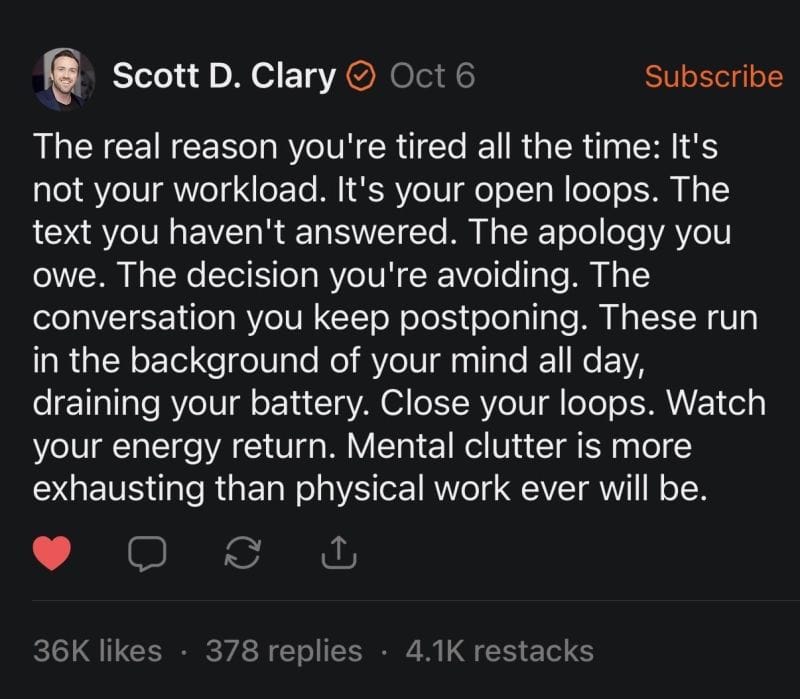
Open loops are unfinished tasks that linger in your working memory and create background anxiety. The concept comes from Bluma Zeigarnik’s 1927 research on memory and unfinished work, and it explains why most overwhelm is mental, not workload.
You wake up at 3 AM with your mind racing about the client presentation, the overdue expense report, and that conversation you need to have with your team member. Your brain cycles through dozens of unfinished tasks, creating a mental storm that prevents rest and clear thinking.
During the day, you sit down to work on strategic planning—the project that could transform your business—but your mind immediately shifts to the urgent email sitting in your inbox. The anxiety about that unread message feels more pressing than the important work in front of you.
You blame yourself for poor time management or lack of discipline. You assume you simply have too much work and need to find ways to do more, faster. Yet adding more tasks to your plate only amplifies the mental noise that’s already overwhelming your cognitive capacity.
The real problem isn’t your workload—it’s the dozens of mental open loops consuming your attention and creating constant background anxiety that makes focused work nearly impossible.
Understanding Mental Open Loops
Psychologist Bluma Zeigarnik discovered that people remember interrupted or incomplete tasks better than completed ones. This cognitive tendency, known as the Zeigarnik Effect, explains why unfinished work creates persistent mental pressure.
Anatomy of Open Loops
Every uncompleted task, unprocessed email, vague commitment, and unclear decision creates a mental open loop that requires ongoing cognitive resources. Your brain maintains these loops in background processing, constantly monitoring for opportunities to complete them.
When you’re carrying 20, 30, or 50 open loops simultaneously, your mental bandwidth becomes severely constrained. The cognitive resources needed for creative thinking, strategic planning, and complex problem-solving get consumed by loop management.
Anxiety Amplification Effect
Open loops don’t just consume mental resources—they generate anxiety that grows with accumulation. Each unresolved commitment adds to your background stress level, creating a persistent sense of urgency that has little correlation with actual importance.
This anxiety becomes self-reinforcing. The more overwhelmed you feel, the less capable you become of addressing the underlying issues. You end up in reactive mode, responding to whatever creates the most immediate psychological pressure rather than working strategically toward your goals.
Priority Distortion Problem
When your brain is managing multiple open loops, it prioritizes based on anxiety level rather than strategic importance. The urgent email feels more pressing than the strategic project because it generates more immediate psychological tension.
This distortion explains why you often find yourself working on trivial but stressful tasks while important long-term projects remain untouched. Your brain’s priority system gets hijacked by emotional intensity rather than rational evaluation.
Three Types of Work
Effective productivity requires understanding that there are actually three distinct types of work, not just the obvious “doing” work that consumes most people’s attention.
Type 1: Capture Work – Externalizing Mental Content
The first type of work involves getting everything out of your head and into trusted external systems. This includes every commitment, task, idea, concern, and vague intention that’s currently occupying mental space.
Complete Externalization Partial capture doesn’t solve the open loop problem. If important items remain in your head, your brain continues background monitoring and anxiety generation. The capture process must be comprehensive across all life domains—work, personal, family, health, finances, and relationships.
Trusted System Requirements Your capture system must earn your brain’s complete confidence that nothing important will be forgotten. This trust develops through consistent use and proven reliability over time. Without this trust, your mind continues maintaining internal backup systems that defeat the purpose.
Frictionless Collection The capture process must be easier than trying to remember items mentally. Any friction in the collection process encourages your brain to continue internal storage, maintaining the open loops you’re trying to eliminate.
Type 2: Thinking Work – Processing and Organizing
The second type of work involves processing captured items into organized, actionable formats. This thinking work transforms vague anxieties into concrete plans that can be executed systematically.
Clarification Process Many captured items are vague concerns that need definition before they can become actionable. “Handle client situation” needs to become “Call John to discuss contract terms” or “Review Sarah’s proposal and provide feedback.”
Organization Systems Processed items need organization into appropriate categories, contexts, and timeframes. Work tasks cluster separately from personal responsibilities. Phone calls group with other communication tasks. Creative work gets protected time blocks.
Priority Frameworks With everything externalized and organized, you can apply rational priority frameworks rather than anxiety-driven selection. Items get evaluated based on impact, urgency, resource requirements, and alignment with your actual goals.
Type 3: Execution Work – Doing the Actual Tasks
The third type of work is the obvious one—actually completing the tasks that advance your objectives. However, this execution work becomes dramatically more effective when it’s built on solid capture and thinking foundations.
Focused Attention When your mental bandwidth isn’t consumed by open loop management, you can focus completely on current tasks. The nagging feeling that you should be working on something else disappears because you know everything important is captured and organized.
Strategic Alignment Execution based on thoughtful processing tends to align with your actual goals rather than just reducing immediate anxiety. You work on projects that create long-term value rather than just eliminating short-term stress.
Sustainable Performance Execution supported by good systems becomes sustainable rather than requiring constant willpower. You’re working with your brain’s natural capabilities rather than fighting against them.
Missing Foundation
The overwhelming majority of professionals skip the first two types of work and jump directly to execution. This approach creates the very problems they’re trying to solve.
Half-Hearted Capture Problem
Many people attempt some form of task capture but do it inconsistently or incompletely. They use multiple systems that don’t integrate, capture only work tasks while leaving personal commitments in their heads, or collect items without processing them into actionable formats.
This partial approach often makes the problem worse by creating the illusion of organization while maintaining most of the mental overhead that generates anxiety and overwhelm.
Thinking Work Avoidance
Even fewer people invest time in systematic thinking about their work. They capture tasks and immediately try to execute them without clarification, organization, or prioritization. This approach leads to working hard on the wrong things.
Thinking work feels unproductive because it doesn’t generate immediate deliverables. However, this investment pays compound returns through better decision-making, reduced rework, and strategic alignment.
Anxiety-Driven Execution
Without proper capture and thinking work, execution becomes driven by whatever creates the most immediate psychological pressure. Important long-term projects get displaced by urgent but trivial tasks that generate more anxiety.
This pattern explains why ambitious professionals often feel busy but unproductive. They’re working hard but not on the activities that would actually advance their most important objectives.
Confidence Transformation
When you implement all three types of work systematically, your relationship with productivity transforms from anxiety-driven reactivity to confidence-based strategy.
Mental Clarity
With all open loops externalized and organized, your mind becomes clear and focused. The constant background chatter about forgotten tasks disappears, freeing cognitive resources for creative thinking and strategic planning.
Priority Confidence
When you’ve thought through your commitments systematically, you can work with confidence that you’re focusing on the right things. The nagging doubt about whether you should be doing something else gets replaced by certainty about your choices.
Reduced Work Hours
Paradoxically, doing the additional capture and thinking work often reduces total working hours. You eliminate the time wasted on poor priority decisions, context switching between unorganized tasks, and redoing work that wasn’t planned properly initially.
Sustainable Performance
This approach creates sustainable high performance rather than requiring constant heroic effort. You’re leveraging systems and processes rather than relying solely on willpower and energy.
Real-World Implementation Examples
Consider how this three-work approach transforms common productivity challenges:
Overwhelmed Executive
Traditional Approach: Tries to remember everything mentally, jumps between urgent emails and strategic projects, feels constantly behind and stressed about forgotten commitments.
Three-Work Approach: Captures all commitments in trusted system, processes them weekly into organized action lists, executes with confidence knowing everything important is handled systematically.
Ambitious Entrepreneur
Traditional Approach: Generates constant new ideas while struggling to complete existing projects, feels overwhelmed by opportunities and unable to focus on execution.
Three-Work Approach: Captures all ideas immediately, processes them monthly to identify highest-potential opportunities, focuses execution on pre-selected priorities while knowing other ideas are safely stored.
Working Parent
Traditional Approach: Tries to juggle work and family commitments mentally, feels guilty about both domains because nothing feels properly organized or prioritized.
Three-Work Approach: Captures all commitments across life domains, organizes them into integrated weekly plans, executes with presence knowing both professional and personal responsibilities are systematically managed.
Building Your Three-Work System
Implementing this approach requires systematic development of capabilities in each work type:
Developing Capture Habits
Start with comprehensive externalization of all mental content. Use whatever tool feels most natural initially—the key is reliability and accessibility. Build the habit of immediate capture whenever new commitments or ideas arise.
Creating Processing Routines
My own processing routine stopped running on discipline. It became the processing routine an agent can run for you, off a single file.
Establish regular times for processing captured items into organized, actionable formats. This might be daily processing of new items and weekly organization of larger projects and priorities.
Designing Execution Systems
Create execution systems that leverage your capture and processing work. This includes contextual task lists, calendar integration, and regular review cycles that maintain system currency.
Iterating and Improving
Refine your approach based on what works and what doesn’t. The goal is creating a sustainable system that reduces anxiety while improving focus and strategic alignment.
Daily and Weekly Workflow
Sustainable implementation requires establishing regular workflows that maintain your three-work system:
Daily Workflow
Morning Processing: Review captured items from the previous day, process them into appropriate categories, and select priorities for current execution.
Execution Blocks: Work on pre-selected priorities with confidence that other commitments are properly managed.
Evening Capture: Collect any new commitments, ideas, or concerns that arose during the day to prevent mental overnight processing.
Weekly Workflow
Complete Review: Process all captured items from the week, organize them into projects and contexts, and align priorities with longer-term objectives.
Strategic Planning: Evaluate progress on important goals and adjust upcoming priorities based on results and changing circumstances.
System Maintenance: Refine capture and processing methods based on what worked well and what created friction during the week.
Goal Achievement Connection
This approach directly addresses why many ambitious professionals struggle to make progress on their most important goals despite working constantly.
From Reactive to Strategic
When your daily work is driven by anxiety about open loops, you end up reactive rather than strategic. You respond to whatever creates the most immediate pressure rather than working systematically toward your objectives.
The three-work approach enables strategic focus by eliminating the anxiety that drives reactive behavior. You can work on important long-term projects because urgent short-term concerns are properly managed.
Sustainable Progress
Goal achievement requires sustained effort over time. Anxiety-driven productivity creates burnout that makes long-term progress impossible. System-supported productivity creates sustainable performance that compounds over time.
Clear Progress Tracking
When your work is organized systematically, you can track progress on important goals more easily. You can see which activities are actually advancing your objectives versus which are just keeping you busy.
Your Open Loop Audit
Understanding your current open loop burden requires honest assessment of what’s currently consuming your mental bandwidth:
- How many unprocessed emails are in your inbox?
- What commitments exist only in your memory?
- Which projects lack clear next actions?
- What decisions are you avoiding or postponing?
- Which relationships need attention but haven’t been scheduled?
Your answers reveal the scope of mental overhead that’s preventing focused work on your most important objectives.
Liberation Effect
When you close mental open loops through systematic capture and processing, the relief is immediate and dramatic. Your mind becomes clear, your priorities become obvious, and your execution becomes focused.
This isn’t about doing more work—it’s about doing the right work with the mental clarity necessary for excellent results. The additional capture and thinking work creates leverage that multiplies the effectiveness of your execution work.
Your path to sustainable productivity starts with understanding that overwhelm comes from mental chaos, not workload. When you organize your commitments systematically, focused work becomes natural rather than forced.
Ready to close your mental open loops and create the clarity that enables focused productivity? Take the Productivity Quiz to discover what’s currently consuming your mental bandwidth and get a personalized plan for implementing the three-work system that eliminates overwhelm while improving results.