
You work harder than ever, yet your most important goals remain frustratingly out of reach. Despite trying countless productivity techniques, apps, and time management strategies, you feel like you’re running on a treadmill—lots of motion, minimal progress.
The problem isn’t your effort or intelligence. You’re likely violating fundamental laws that govern how productivity actually works.
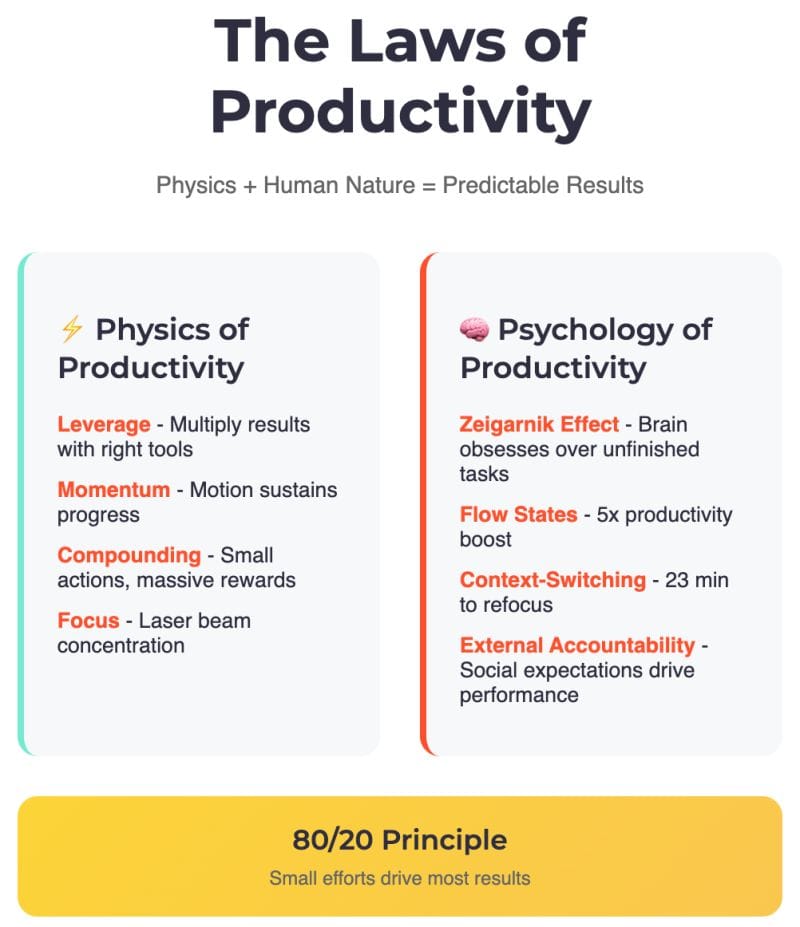
Productivity operates according to immutable principles that combine physics, biology, and psychology. Just as you can’t violate the law of gravity without consequences, you can’t achieve sustainable high performance while ignoring these foundational laws.
Understanding and applying these nine laws transforms scattered effort into focused results, turning your ambitions from distant dreams into inevitable outcomes.
Foundation: Why Laws Matter More Than Tactics
Most productivity advice focuses on tactics—specific techniques, tools, or habits that promise immediate improvement. While tactics can be useful, they’re only effective when built on solid foundational principles.
The laws of productivity are different. They represent universal patterns that govern how work gets done effectively, regardless of your industry, role, or personal circumstances. Violating these laws creates friction and inefficiency. Following them creates exponential results with less effort.
These laws emerge from three domains: physics (how energy and systems work), psychology (how human minds operate), and observed patterns in both natural and artificial systems. Together, they form a comprehensive framework for understanding why some approaches work and others fail.
Physics of Productivity
The first four laws derive from fundamental principles of physics, applied to human work and achievement:
Law 1: Leverage – Multiply Your Impact
Leverage allows you to multiply results by applying the right tools, strategies, and systems. Small inputs create disproportionately large outputs when you find the right leverage points.
Physical Leverage in Action A simple lever can help you move objects many times your body weight. Similarly, productivity leverage helps you accomplish results far beyond your direct effort. The consultant who creates a framework used by hundreds of clients leverages their thinking across multiple applications. The manager who develops a training system leverages their knowledge across their entire team.
Digital and Strategic Leverage Modern technology provides unprecedented leverage opportunities. Automation handles routine tasks. Templates accelerate repetitive work. Systems scale your decision-making across multiple situations. The key is identifying where small investments in leverage creation produce ongoing benefits.
Leverage Through Relationships Building strong relationships creates leverage through other people’s capabilities, networks, and resources. The executive with excellent relationships can accomplish through influence what would require direct effort from someone with weaker connections.
Law 2: Momentum – Sustain Effortless Progress
Once you’re in motion, sustaining progress becomes effortless. It’s easier to work on something every single day than to put in massive effort occasionally. Consistent habits compound into automatic progress.
The Physics of Starting Newton’s first law states that objects at rest tend to stay at rest, while objects in motion tend to stay in motion. This applies directly to productivity. Starting is often the hardest part of any project. Once you begin, continuation requires less energy than initiation.
Daily Consistency vs. Sporadic Intensity Writing 500 words daily for a year produces a book with less effort than attempting to write intensively for a few weeks. Daily exercise maintains fitness more easily than sporadic intense workouts. Small, consistent actions overcome large, irregular efforts.
Momentum Through Systems Well-designed systems create momentum by reducing the friction of starting. When your tools, environment, and processes support immediate action, maintaining progress becomes automatic rather than requiring constant willpower.
Law 3: Compounding – Exponential Returns from Small Actions
Incremental, regular improvements accumulate over time to deliver exponential results. Small daily actions can produce massive long-term rewards when they compound consistently.
The Mathematics of Compounding Just as financial investments compound through reinvested returns, skill development compounds through consistent practice. Each day’s improvement builds on previous gains, creating exponential rather than linear growth.
Skill Compounding The professional who reads 30 minutes daily doesn’t just gain knowledge—they develop pattern recognition, critical thinking, and domain expertise that accelerates future learning. The compounding effect makes each subsequent learning session more valuable.
Relationship and Reputation Compounding Consistent high-quality work compounds into reputation. Small acts of reliability compound into trust. Regular relationship maintenance compounds into a powerful network that creates opportunities and support.
Law 4: Focus – Concentrate Energy for Maximum Impact
Focus concentrates your energy like a laser beam. Instead of scattered effort, you create disproportionate impact through depth rather than breadth. Single-tasking multiplies effectiveness compared to multitasking.
The Physics of Concentrated Energy Diffused sunlight warms the ground. Concentrated sunlight through a magnifying glass can start fires. Similarly, scattered attention produces mild results while focused attention creates breakthrough outcomes.
Cognitive Focus Benefits When you concentrate fully on one task, your brain can access its full processing power. Working memory, pattern recognition, and creative connections all function optimally during focused work sessions.
Focus Through Elimination True focus requires saying no to good opportunities that don’t align with your priorities. The most productive individuals aren’t those who do more things—they’re those who do fewer things with greater intensity and quality.
Psychology of Productivity
The next four laws emerge from how human psychology affects work performance:
Law 5: The Zeigarnik Effect – Mental Clarity Through Closure
Your brain obsesses over unfinished tasks. Without closure from a reliable productivity system, your brain is forced to remember open loops, substantially reducing mental clarity and focus.
The Psychological Burden of Open Loops Psychologist Bluma Zeigarnik discovered that people remember interrupted tasks better than completed ones. This mental tendency, while useful for survival, becomes counterproductive in modern work environments with dozens of ongoing commitments.
The Cognitive Cost of Mental Task Management When your brain serves as your task manager, it consumes cognitive resources that could be used for creative thinking and problem-solving. The background mental processing of remembering tasks creates fatigue and reduces focus quality.
System-Based Closure Reliable external systems provide psychological closure by assuring your brain that important tasks are safely captured and will surface at appropriate times. This frees mental bandwidth for higher-value thinking.
Law 6: Deep Work and Flow States – 5x Productivity Multiplication
Sustained, distraction-free effort where challenge meets skill creates flow states. Research shows this multiplies productivity fivefold, but even brief interruptions can double error rates.
The McKinsey Flow Research A 10-year McKinsey study found that top executives are 500% more productive when in flow states. These periods of optimal performance occur when skills match challenges and distractions are eliminated.
Flow State Conditions Flow requires clear goals, immediate feedback, and a balance between challenge and skill level. Too easy and you become bored. Too difficult and you become anxious. The sweet spot creates effortless concentration and peak performance.
Protecting Deep Work Creating conditions for deep work requires intentional design of your environment, schedule, and attention. This means eliminating notifications, batching shallow tasks, and protecting uninterrupted time blocks for your most important work.
Law 7: Context Switching Costs – The Hidden Productivity Killer
Even brief context switches of 2-3 seconds can more than double error rates. Research shows a 40% productivity decrease for those who context switch compared to those who maintain focus.
The Neuroscience of Task Switching Your brain requires time to fully disengage from one context and engage with another. During this transition period, performance suffers and errors increase. The more complex the tasks, the higher the switching cost.
The Multitasking Myth What people call multitasking is actually rapid task switching. The brain cannot truly focus on multiple complex tasks simultaneously. Each switch creates a performance penalty that accumulates throughout the day.
Batching for Efficiency Grouping similar tasks together minimizes context switching costs. Handling all phone calls in one block, processing emails at designated times, and dedicating specific periods to creative work all reduce the mental overhead of constant switching.
Law 8: External Accountability – Social Motivation for Follow-Through
Social expectations drive follow-through and improved performance. Research consistently demonstrates that individuals execute responsibilities more effectively when held accountable to people they respect and trust.
The Psychology of Social Commitment Public commitments create psychological pressure to follow through. When others know about your goals and deadlines, you’re more likely to complete them to maintain your reputation and relationships.
Accountability Partner Benefits Regular check-ins with accountability partners provide external motivation, perspective on challenges, and celebration of progress. This social support system helps maintain momentum during difficult periods.
Team and Organizational Accountability Workplace accountability systems create cultures of execution. When teams have clear expectations, regular reviews, and mutual support, individual and collective performance improves dramatically.
The Universal Pattern: The 80/20 Rule
Law 9: The Pareto Principle – Focus on the Vital Few
The 80/20 rule appears in both natural and artificial systems, revealing that a small proportion of efforts drives most results. Identifying and focusing on these vital few activities becomes the ultimate multiplier.
Beyond Simple Time Management The Pareto Principle isn’t just about time allocation—it applies to relationships, skills, opportunities, and decisions. Twenty percent of your clients might generate 80% of your revenue. Twenty percent of your skills might create 80% of your value. Twenty percent of your decisions might determine 80% of your outcomes.
Dynamic 80/20 Analysis Your vital 20% changes over time as circumstances evolve. Regular analysis helps identify which activities currently provide the highest leverage, allowing you to adjust focus as priorities shift.
Compound 80/20 Effects When you focus on your 20% activities consistently, they often compound into even greater leverage. The high-value relationships become stronger. The key skills become more refined. The important decisions become easier to recognize.
Integrating the Laws into Daily Practice
These nine laws work synergistically when integrated into a comprehensive productivity system:
Daily Application Framework
Morning Focus Sessions Start each day with deep work on your most important 20% activities. This leverages your peak mental energy and builds momentum for the entire day.
System-Based Task Management Use external systems to capture all commitments, providing Zeigarnik closure while enabling clear prioritization based on the 80/20 principle.
Context-Batched Workflow Group similar activities together to minimize switching costs while maintaining focus on high-leverage work.
Accountability Integration Build regular check-ins and social commitments around your most important goals to maintain motivation and follow-through.
Weekly and Monthly Optimization
Leverage Review Regularly assess which tools, systems, and strategies provide the greatest multiplication of your efforts. Invest time in improving your highest-leverage activities.
Momentum Maintenance Evaluate which daily habits and systems support consistent progress versus those that create friction and resistance.
Focus Protection Analyze your attention patterns and eliminate sources of distraction that prevent deep work and flow states.
The Compound Effect of Law-Based Productivity
When you align your approach with these fundamental laws, the benefits compound over time:
Enhanced Decision Making
Understanding leverage, focus, and the 80/20 principle improves your ability to choose the right opportunities and say no to attractive distractions.
Sustainable High Performance
Working with psychological laws rather than against them creates sustainable productivity that doesn’t require constant willpower or stress.
Exponential Results
The combination of leverage, momentum, compounding, and focus creates exponential rather than linear improvement in your outcomes.
Reduced Effort, Increased Impact
By following natural laws rather than fighting against them, you accomplish more meaningful work with less stress and effort.
Your Path to Law-Based Productivity
Understanding these laws intellectually is just the beginning. Real transformation comes from systematically integrating them into your daily work and life practices.
The most effective approach involves building systems that naturally incorporate multiple laws simultaneously. A well-designed productivity system provides Zeigarnik closure, enables focus and deep work, minimizes context switching, creates accountability, and helps you identify your personal 80/20 activities.
Rather than trying to apply each law individually, look for opportunities to create compound benefits by addressing multiple laws through single systems and practices.
Your success isn’t determined by how hard you work, but by how well you align your efforts with the fundamental laws that govern productivity. When you stop fighting against these immutable principles and start leveraging them, extraordinary results become not just possible, but inevitable.
Ready to build a productivity system that incorporates all nine laws for exponential results? Take the Productivity Quiz to discover which laws you’re currently violating and get a personalised plan for aligning your approach with these fundamental principles for sustainable high performance.