
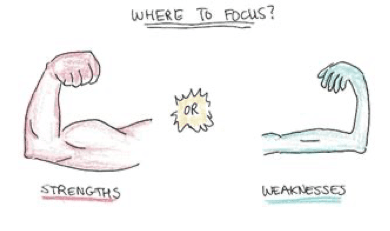
You’ve spent years developing your analytical skills, strategic thinking, and technical expertise. These strengths have driven your career success and earned recognition from colleagues and managers. Yet your latest performance review focuses primarily on your “areas for development”—public speaking, relationship building, administrative follow-through.
Your manager explains that to reach the next level, you need to become more well-rounded. The promotion depends on eliminating weaknesses, not just excelling at your strengths. You leave the meeting frustrated, wondering why your exceptional capabilities in certain areas matter less than your mediocre performance in others.
This frustration intensifies if you’re considering entrepreneurship. You’ve watched successful founders who are terrible at operations, weak at finance, or poor at marketing—yet they’ve built thriving businesses by focusing relentlessly on their unique strengths whilst delegating or automating their weaknesses.
The confusion stems from a fundamental misunderstanding: corporate environments and entrepreneurship operate under completely different success rules. What works in one context actively undermines success in the other.
The Corporate Success Formula
Corporate advancement follows predictable patterns shaped by organisational structures and competitive dynamics.
The Well-Rounded Requirement
In corporate settings, promotions depend on demonstrating competence across multiple dimensions. You need technical skills, leadership capabilities, communication abilities, strategic thinking, and operational execution.
This requirement exists because corporate roles typically involve managing diverse responsibilities. Senior leaders coordinate across functions, communicate with varied stakeholders, and handle situations requiring different skill sets. Glaring weaknesses in any area create vulnerabilities that can undermine overall effectiveness.
Think of helping your child prepare for exams. They’re strong in mathematics but struggle with languages. Your focus naturally shifts to the weaker subjects because that’s where the biggest opportunity exists to improve their overall score.
The same logic applies in corporate environments. Your exceptional analytical skills might already be strong enough. The bigger opportunity for improvement lies in developing your weaker areas—presentation skills, relationship building, or whatever gaps exist in your profile.
Finite-Sum Competition
Corporate advancement operates as a finite-sum game. There are limited promotion opportunities, and you’re evaluated relative to peers competing for the same positions.
When only three people can be promoted to senior director, being exceptional in one area whilst weak in others creates competitive disadvantage. Your peers who are good across multiple dimensions—even if not exceptional in any single area—may advance more reliably.
This curve-based evaluation system rewards consistency over excellence. Being at the 90th percentile in three areas and 40th percentile in two areas often loses to being at the 70th percentile across all five dimensions.
Risk Mitigation Imperative
Organisations minimise risk by promoting people who demonstrate broad competence. A candidate with obvious weaknesses represents potential failure points that could impact team performance, client relationships, or strategic initiatives.
Even if your strengths are exceptional, your weaknesses create uncertainty. Can you handle the communication demands of senior leadership? Will your operational gaps undermine team execution? These concerns often outweigh the value of your distinctive capabilities.
Entrepreneurial Success Formula
Entrepreneurship operates under fundamentally different rules that reward opposite behaviours.
Jagged Edge Advantage
In entrepreneurship, your distinctive capabilities—the areas where you’re exceptionally strong—become your primary competitive advantage. These “jagged edges” represent what makes you uniquely valuable in the marketplace.
The entrepreneur who’s brilliant at product design but terrible at sales builds a business around exceptional products whilst hiring sales talent or partnering with distribution experts. The founder who excels at relationship building but struggles with operations focuses on client development whilst systematising operational functions.
Your weaknesses don’t disappear, but they become problems to solve through delegation, automation, or elimination rather than personal development priorities.
Infinite-Sum Opportunity
Entrepreneurship operates as an infinite-sum game. Success doesn’t require beating competitors in a zero-sum promotion race. You can build a thriving business serving a specific niche with your unique strengths, whilst competitors succeed serving different niches with their distinct capabilities.
This dynamic rewards specialisation and differentiation. Being exceptional in one or two areas whilst adequate or even poor in others can create more business success than being merely good across all dimensions.
The market rewards unique value creation, not well-rounded competence. Customers choose you because you excel at solving their specific problem, not because you demonstrate balanced capabilities across all business functions.
Leverage Multiplication
Entrepreneurship enables you to multiply the impact of your strengths through systems, teams, and technology. Your exceptional strategic thinking can be leveraged across dozens of client engagements. Your unique creative approach can be systematised and scaled.
This multiplication effect means that improving your strengths from 90th percentile to 95th percentile often creates more value than improving weaknesses from 40th to 60th percentile. Small enhancements to exceptional capabilities compound into substantial business advantages.
AI Amplification Effect
Artificial intelligence has made the entrepreneurial advantage of leveraging strengths even more pronounced.
Strength Multiplication at Scale
AI tools can amplify your natural talents by 10x, 20x, or even 100x. The strategic thinker can use AI to rapidly analyse market data, test hypotheses, and generate insights at unprecedented speed. The creative communicator can leverage AI to produce content, refine messaging, and reach audiences at scale.
This amplification works best when applied to existing strengths. AI enhances what you’re already good at, multiplying your natural advantages rather than compensating for fundamental weaknesses.
Weakness Mitigation Through Automation
Simultaneously, AI can handle many functions where you’re weak, reducing the penalty for those weaknesses. The entrepreneur poor at administrative follow-through can automate scheduling, tracking, and communication. The founder weak at financial analysis can use AI tools for forecasting, budgeting, and reporting.
This doesn’t eliminate the need to address weaknesses, but it dramatically reduces the cost of having them. You can maintain adequate performance in weak areas through technology whilst focusing personal development on strengthening your distinctive capabilities.
Competitive Divergence
As AI becomes more accessible, the competitive advantage shifts even more strongly toward unique human strengths. Technical tasks that previously required diverse capabilities can increasingly be automated. What remains uniquely valuable are the distinctive insights, relationships, creative approaches, and strategic thinking that AI cannot replicate.
Entrepreneurs who’ve built businesses around their unique strengths—and used delegation, systems, and now AI to handle everything else—will increasingly outperform those who’ve spent energy becoming well-rounded generalists.
Tim Ferriss Insight
Tim Ferriss captures this principle perfectly: “It is far more lucrative and fun to leverage your strengths instead of attempting to fix all the chinks in your armour. The choice is between multiplication of results using strengths or incremental improvement fixing weaknesses that will, at best, become mediocre.”
This isn’t just philosophical preference—it’s mathematical reality. Improving a strength from excellent to exceptional creates exponential returns. Improving a weakness from poor to adequate creates linear returns at best.
The multiplication effect applies to both financial returns and personal satisfaction. Working in your areas of strength generates energy and engagement. Working on weaknesses creates drain and frustration.
Ferriss continues: “Focus on better use of your best weapons instead of constant repair. The superheroes you have in your mind (idols, icons, titans, billionaires, etc.) are nearly all walking flaws who’ve maximised 1 or 2 strengths.”
This observation reveals an important truth: exceptional success rarely comes from balanced competence. It comes from distinctive excellence in specific areas, combined with adequate systems for managing everything else.
Navigating the Transition
For professionals considering the shift from corporate employment to entrepreneurship, understanding these different success formulas becomes crucial.
Corporate Preparation Paradox
Corporate experience provides valuable skills—project management, stakeholder coordination, strategic thinking, professional communication. These capabilities support entrepreneurial success.
However, the corporate habit of fixing weaknesses can become counterproductive when transitioning to entrepreneurship. The mindset shift from “become well-rounded” to “leverage distinctive strengths” requires conscious recalibration.
Identifying Your Distinctive Strengths
The transition requires honest assessment of where you’re genuinely exceptional versus merely competent. What capabilities do you possess that create unique value? What work energises you and produces disproportionate results?
These strengths might be technical skills, relationship capabilities, strategic insight, creative problem-solving, or operational execution. The specific strengths matter less than their distinctiveness and your genuine excellence in those areas.
Building Systems Around Weaknesses
Rather than trying to improve weak areas through personal development, entrepreneurial success requires building systems that handle those functions adequately without consuming your personal time and energy.
This might mean hiring team members whose strengths complement your weaknesses, implementing technology that automates functions you handle poorly, or partnering with others who excel where you struggle.
Hybrid Approach for Corporate Entrepreneurs
Some professionals operate in hybrid contexts—corporate roles with entrepreneurial elements, or entrepreneurial ventures that require corporate-style stakeholder management.
Strategic Weakness Management
Even in entrepreneurial contexts, some weaknesses require attention because they create business-critical vulnerabilities. The founder who’s terrible at financial management still needs adequate financial systems and oversight.
The key distinction is between weaknesses that can be delegated or systematised versus those that require personal capability development. Focus personal development on the latter whilst building systems for the former.
Strength Amplification Priority
Regardless of context, prioritising the amplification of your distinctive strengths creates more value than balanced competence development. Even within corporate settings, being known for exceptional capabilities in specific areas can create more career opportunities than being adequate across all dimensions.
The challenge is navigating corporate evaluation systems that explicitly reward well-roundedness. This might require strategic weakness management—developing just enough competence to avoid disqualification whilst investing most development energy in strengthening your distinctive capabilities.
Your Success Formula Assessment
Understanding which success formula applies to your situation requires honest evaluation of your context and aspirations.
If you’re building a corporate career, the well-rounded approach remains necessary for advancement. Focus on identifying and addressing the weaknesses that create the biggest obstacles to promotion whilst maintaining your existing strengths.
If you’re pursuing entrepreneurship, the strength-leverage approach becomes paramount. Identify your distinctive capabilities, build your business model around them, and create systems that adequately handle everything else without requiring personal excellence.
If you’re in transition or operating in hybrid contexts, you’ll need to consciously navigate between these different formulas based on specific situations and stakeholders.
The productivity implications are significant. Your personal productivity system should support whichever success formula applies to your context. Corporate professionals need systems that help develop broad competence. Entrepreneurs need systems that maximise the leverage of their distinctive strengths.
Ready to build a productivity system that aligns with your actual path to success—whether corporate advancement, entrepreneurial growth, or hybrid contexts? The Productivity Quiz helps you understand your unique strengths, identify where you’re currently spending energy, and create personalised strategies for maximising your distinctive capabilities rather than just fixing weaknesses that may not matter for your actual goals.
This is what makes several ventures possible at once. More on running several ventures off one board.