
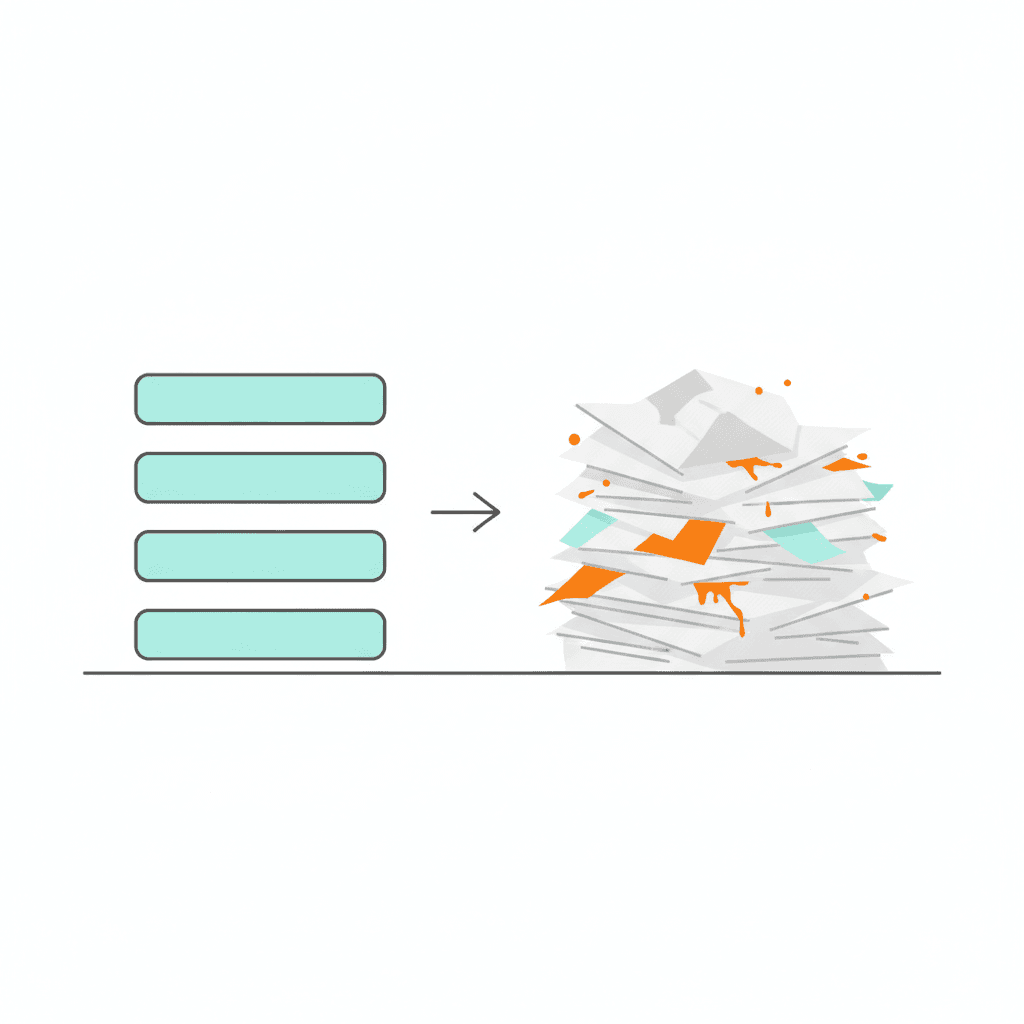
Decision making for business owners is the process of choosing which tasks, projects, and requests to act on, defer, or discard — across every area of the business, repeatedly, under the same time and energy constraints as everyone else.
The volume is the problem. A person in a defined role makes decisions inside a bounded scope. A business owner makes decisions across every scope at once: client strategy, team priorities, operations, finance, marketing, and their own schedule — often within the same hour. Studies put the average adult at around 35,000 decisions daily. For a business owner running multiple functions, the figure is higher, and a larger share of those decisions are genuinely consequential.
What decision fatigue actually costs
Decision fatigue is the gradual degradation in decision quality that comes from making too many decisions in sequence. Research on judges found that favourable outcomes declined consistently across the day and reset after breaks. The mechanism applies to business owners too: each decision draws on a finite pool of cognitive capacity, and that pool is depleted by every decision that draws from it — regardless of whether the decision was important.
The practical result is predictable. The business owner who spends the first three hours triaging email, answering messages, and responding to inbound requests arrives at the moment when strategic thinking is needed with less capacity than they started with. The decisions that matter most — positioning, key hires, which clients to take or turn down — receive the worst version of their thinking.
Most attempts to fix this focus on time management. The actual constraint is decision management: reducing the number of decisions the owner needs to make personally, and protecting the cognitive energy required for the ones that cannot be delegated.
A three-layer decision system
The productivity framework for entrepreneurs in the NP System organises decisions across three layers. Each layer requires different attention and runs on a different cadence, so the most consequential decisions receive the freshest thinking.
Layer 1: Quick triage (daily inbound)
The five Ds handle the daily inflow. Each incoming item — email, message, request, idea — is processed through one of five routes: Done immediately if it takes under two minutes, Deferred to a specific date, Delegated with a clear brief, Diminished into a smaller commitment, or Deleted. This is a triage pass, not a prioritisation pass. It clears the inflow into the right buckets without requiring deep evaluation at the point of arrival.
The critical discipline is running this pass at fixed times rather than continuously. Processing inbound continuously means the inbox sets the agenda in real time. Two defined processing windows per day — typically mid-morning and early afternoon — means everything between them goes into the capture system rather than into your attention. The reactive business owner pattern breaks the moment the triage pass runs on a schedule rather than in response to arrival.
Layer 2: Priority decisions (weekly planning)
Once the inflow is processed, the Eisenhower Matrix provides the weekly prioritisation frame. Tasks are sorted by urgency and importance: what to do this week, what to schedule, what to delegate, and what to drop entirely. This pass happens at the weekly review, not in the moment — which means it runs on a full cognitive budget, not a depleted one.
Sixty minutes, once a week, applied to the processed task list produces a working priority order for the week ahead. The remaining five days don’t start from a blank page — they start from a ranked list that was built at the beginning of the week when thinking was fresh. This is the designed slot for priority decisions: a contained, scheduled session rather than a continuous stream of real-time judgements.
Layer 3: Strategic decisions (Rocks)
Rocks are the two or three outcomes the week exists to produce — the most important things, defined before the week begins rather than revealed by it. Setting Rocks and MITs before the week starts means every incoming priority gets assessed against a pre-existing decision rather than requiring a fresh evaluation each time.
The protected first block — the Monk Mode Morning — ensures the Rock receives the owner’s best thinking before anything else claims it. When the Rock is set on Sunday, Monday morning already has a clear answer to the question of what the first block is for. The strategic decision is made once per week, not repeated every morning under the pressure of whatever arrived overnight.
The result across all three layers is that the business owner makes far fewer real-time decisions. Triage is processed on a schedule. Priorities are set weekly. Rocks require fresh strategic thinking just once, at the moment of highest capacity.
Where the system breaks
The most common failure isn’t the wrong framework — it’s applying Layer 2 or Layer 3 thinking to Layer 1 items. When a business owner pauses in the middle of the day to evaluate whether an incoming request is genuinely important, they’re spending priority-decision energy on a triage decision. The five Ds exist to make that evaluation automatic and fast.
The second failure is making Layer 3 decisions mid-week. When a Rock gets reconsidered on Wednesday because something urgent arrived Tuesday, the week loses its anchor. The Rocks discipline is specifically to hold the Rock unless something genuinely displaces it — meaning another high-importance, high-urgency item — and to name what the Rock displaced rather than quietly dropping it. What you stop doing is as much a decision as what you start.
Both failures have the same root: the decision is being made at the wrong layer, at the wrong time, with the wrong quality of attention. The system’s job is to route each decision to the right layer and the right moment.
Where AI changes the equation
Once the three layers are in place, Claude handles a meaningful share of Layer 1 autonomously.
Categorising inbound, drafting responses for delegatable requests, flagging items that need the owner’s attention versus items that can be resolved by someone else, summarising long threads — these are triage decisions. They consume time without requiring the owner’s judgement. When they run inside a properly briefed Claude session, the two hours that would otherwise go on morning triage run in twenty minutes.
The remaining attention is available for Layers 2 and 3. The context is what makes the delegation work: a session with the owner’s current projects, active clients, and standing priorities already loaded makes triage decisions without constant interruption. Without that context, every item requires clarification before it can be processed.
The Claude project manager setup covers the context file structure that makes this reliable — the same frame of reference across every session, no rebuild from scratch each morning.
How to start
If you’re an overwhelmed business owner who finds strategic decisions consistently happening at low energy, the sequence matters more than the tools.
Start with Layer 1. The five Ds, applied twice a day to a captured inflow, clears enough space that the weekly planning session runs on surplus rather than deficit. Add the weekly review once the daily pass is reliable. Set Rocks once the weekly review is consistent.
The capacity for good decisions doesn’t come from trying harder to decide well. It comes from protecting the energy required for the decisions that matter, by systematically removing the ones that don’t require the owner’s judgement at all.
The free productivity quiz identifies which of the four phases — Capture, Process, Plan, or Do — is the weakest link in your current setup. It takes five minutes. Or if you want the full decision system installed, the free NP System course walks through all four phases sequenced for business owners who want to build this properly once.
