
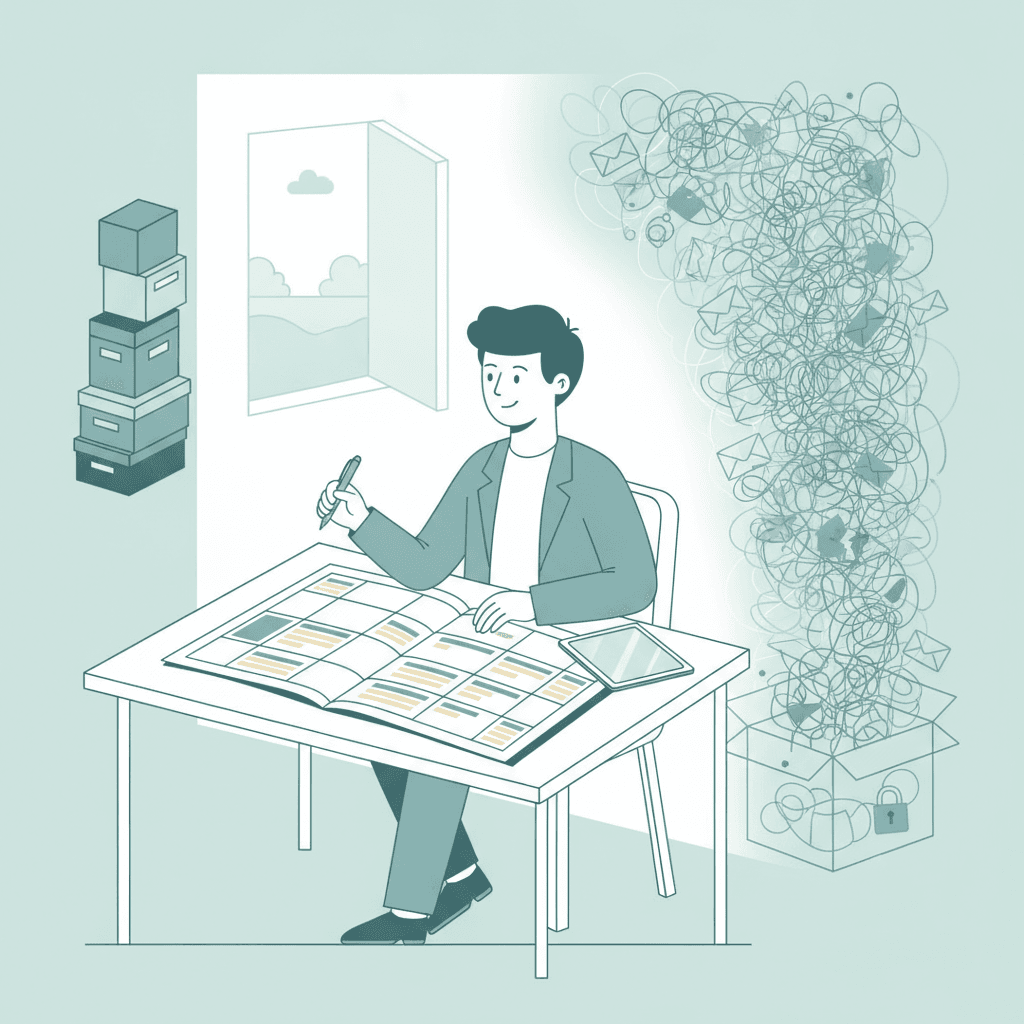
Reactive mode is what happens when a business grows faster than the system governing it. You start the week with a plan. By Tuesday, the inbox has replaced it. By Thursday, you’re doing good work — just not the work that was supposed to move the business forward.
This is not a discipline problem. The business owners caught in reactive mode are almost always hardworking and capable. The issue is structural: when decision volume outgrows the capacity to handle it, the brain defaults to the only filter available — respond to whatever is loudest. The inbox wins because it’s louder than the strategic work sitting in a notebook somewhere.
This post covers what creates reactive mode, what it actually costs, and the three structural shifts that move you out of it. These form the core of the Plan phase in the NP System — the phase that determines whether your week runs on your intentions or on everyone else’s.
Why growing businesses produce reactive owners
When a business is small, the owner can hold the whole thing in their head. Five clients, ten tasks, two real priorities. As the business grows, the inputs multiply: more clients, more team members, more decisions per day, more communication across more channels.
The tasks that used to number ten become forty. The priorities that used to be two become seventeen. And because no system was built to handle the growth, the brain defaults to the only strategy available: respond to whatever is loudest right now.
This is the pattern most overwhelmed business owners share. They’re not lazy. They’re not failing. They’re running a growing business with the mental operating system they built when the business was smaller, and that system is no longer sufficient for the volume it’s handling.
Reactive mode compounds because the louder the inbox gets, the more the strategic work slips. The more the strategic work slips, the more problems surface that need reactive responses. The cycle feeds itself.
What reactive mode actually costs
The visible cost is time: hours absorbed by other people’s agendas, less time left for the work that moves the business forward.
The less visible cost is thinking quality. Your best thinking — the kind that produces real strategy, not just task completion — requires time to settle. A brain switching contexts every twenty minutes never gets the runway it needs to produce its best work. Shallow responses to urgent requests are quick; the thinking that changes the trajectory of the business is slow, and it dies in a fragmented day.
The deepest cost is cumulative. Strategic work requires sustained attention across multiple sessions. If every session is interrupted before it gains traction, the work doesn’t progress — it restarts. You end the week technically busy and substantively behind. That gap widens every week reactive mode runs.
Three structural shifts that move you out of reactive mode
Getting out of reactive mode isn’t about being tougher about your time. It’s about installing a system that makes the decision for you. The NP System builds this through three steps in its Plan phase.
Step 1: Capture everything out of your head
Reactive mode partly runs on the background fear that if you don’t respond immediately, something will be lost. That fear is legitimate when your head is the only storage system you have.
The fix is a trusted capture system: one place where every task, idea, commitment, and request lands immediately, so your brain can let it go. When the capture system is complete and trusted, you no longer need to keep scanning for what you might be forgetting. That drop in background noise is what creates the mental space for strategic thinking.
The GTD capture habit covers the mechanics of this in detail — the tools, the inboxes, and the discipline of capturing before categorising. See the GTD capture method for a step-by-step setup. The key principle: capture first, decide later. Mixing the two is what slows the capture habit down until it stops.
Step 2: Process the capture list on a schedule
Capturing everything doesn’t mean acting on it immediately. It means acknowledging it exists and deciding what it is — on a schedule, not as things arrive.
The NP System’s five Ds of triage apply to every item in the capture list: do it now (under two minutes), defer it to a specific date, delegate it with a clear brief, diminish it into a smaller commitment, or delete it. The discipline is running this pass at a fixed time rather than processing as you go. Processing as you go keeps you in reactive mode. A defined triage pass puts you in control of the queue.
This step also applies to email. Time-blocking communications into two or three passes per day — rather than leaving the inbox open all day — means the inbox sorts on your schedule, not on the sender’s.
Step 3: Plan the week before it starts
The weekly plan is where proactive mode is actually installed. Before the week begins, you set your Rocks and MITs — the two or three outcomes that matter most this week — and allocate specific time blocks to protect them. Everything else fits around the Rocks, not the other way around.
The weekly review is where this plan is built. It typically takes 45 to 60 minutes on a Sunday evening or Monday morning. In that session, you review last week’s progress, clear the capture list, set this week’s Rocks, and block the protected time in the calendar.
When Monday morning begins with a plan already made, the inbox is no longer the first thing that sets the agenda. You arrive knowing what the week is for. That is the practical difference between reactive and proactive: not that the inbox disappears, but that it no longer runs the day.
Why this doesn’t work without the full structure
The common failure is installing one of the three steps without the others.
The capture system alone produces a growing list with no exit. You capture more, process less, and the list becomes another source of anxiety rather than relief.
The weekly plan alone breaks when the capture list underneath it is unreliable. You plan the week on Sunday, then something surfaces from memory on Tuesday that wasn’t in the plan and derails it. The plan only holds when the capture system feeds it complete information.
The three steps work as a closed loop: capture ensures nothing is lost; processing ensures everything is assessed; planning ensures the most important work gets protected time. Remove any one element and the loop breaks. This is why the productivity framework for entrepreneurs built into the NP System runs all three phases in sequence, one per week, during the install.
Methods like task batching and the Eisenhower Matrix work better once this underlying structure is in place. They’re filtering tools. Their job is to sort what’s already been captured and processed. Without the first two steps running reliably, the filtering tools are sorting an incomplete picture.
Where Claude fits in the transition
Once the capture and process structure is in place, Claude becomes a significant accelerator on the planning step.
The weekly plan session runs faster when you paste your processed task list into a session and ask Claude to help you set the Rocks and build the calendar. The cognitive load of planning — what can wait, what depends on what, which blocks need protection — moves faster with a second perspective that already knows the context of your work.
The triage step benefits too. Decisions that feel ambiguous often resolve when you articulate them. Describing a task to Claude, naming the outcome and the effort required, is often enough to reveal whether it belongs in this week’s plan or in the someday/maybe list.
See how to turn Claude into a project manager for the context file setup that makes these weekly sessions consistent across every project you run.
The first week
Most business owners who install these three steps notice a shift within two to four weeks. The first week feels unfamiliar — the habit of checking the inbox first thing is deeply ingrained, and the pull to respond immediately to what arrives is strong. By week three, the new rhythm is the default.
The biggest shift most owners report is not more output but more calm: the sense that they’re running the week rather than surviving it. That shift comes from knowing what the week is for before it begins, and having a system that keeps the plan from unravelling every time something arrives.
Reactive mode isn’t a permanent state. It’s what a business produces when there’s no system governing what gets the owner’s attention. Install the system and the inputs stop running the day.
The free productivity quiz surfaces which of the three phases — capture, process, or plan — is the weakest link in your current setup. It takes about five minutes. Or if you want the full install, the free NP System course walks through all four phases across eleven modules, starting with capture.
