
You watch certain colleagues effortlessly navigate complex projects while maintaining work-life balance. They seem to accomplish more in focused hours than others achieve in frantic days. Their success appears almost natural, as if they possess an innate productivity gene that others lack.
Meanwhile, you struggle with overflowing to-do lists, competing priorities, and the constant feeling that important work remains undone. You wonder if some people are simply born more productive, destined for efficiency while others fight an uphill battle against chaos and overwhelm.
The truth is more encouraging: productivity operates according to learnable rules, just like negotiation, public speaking, or any other professional skill. While some individuals may have natural advantages, anyone can master the fundamental principles that govern effective work.
These principles aren’t arbitrary productivity hacks or motivational platitudes. They emerge from the intersection of physics and human psychology—immutable laws that determine how work gets done efficiently and sustainably.
Productivity Learning Curve
Just as negotiation skills develop through understanding and practicing fundamental principles, productivity mastery follows a similar trajectory.
Natural vs. Learned Ability
Some people intuitively understand how to leverage their time and energy effectively. They naturally batch similar tasks, protect deep work time, and maintain systems that support focused effort. These individuals often can’t explain their methods—they simply operate according to effective patterns.
Others must consciously learn and practice productivity principles. They need to understand why certain approaches work and deliberately implement systems that support effective work habits. This learning process, while requiring initial effort, often leads to more sophisticated and adaptable productivity capabilities.
Fundamentals Advantage
In negotiation, understanding core principles—like identifying mutual interests, preparing alternatives, and managing emotions—provides disproportionate advantages over tactical techniques. Similarly, productivity fundamentals create leverage that specific tools or techniques cannot match.
Master negotiators don’t just use clever tactics; they understand the psychological and strategic principles that make negotiations successful. Master productivity practitioners don’t just use the latest apps; they understand the underlying rules that make any system effective.
Compounding Returns from Mastery
Advanced negotiators earn significantly more and achieve better outcomes than those with basic skills. The difference isn’t proportional to effort—it’s exponential. Small improvements in fundamental understanding create disproportionate results.
Productivity mastery follows the same pattern. Understanding and applying core principles creates compound benefits that far exceed the initial learning investment.
Dual Nature of Productivity
Productivity operates at the intersection of physics and human psychology. Effective systems must account for both domains to create sustainable results.
Physics: The Mechanics of Work
Physical laws govern how energy, systems, and processes operate. These principles apply to human work just as they apply to mechanical systems. Understanding these patterns helps design approaches that work with natural forces rather than against them.
Psychology: The Human Element
Human behaviour follows predictable patterns based on motivation, attention, and cognitive processing. Productivity systems that ignore psychological realities fail despite technical elegance.
Integration Challenge
The most effective productivity approaches integrate both domains. They leverage physical principles like momentum and focus while accounting for psychological realities like attention limits and motivation patterns.
Physics of Productivity
Four fundamental physical principles govern how productive work happens:
Leverage: Multiplying Input Effects
Leverage allows small inputs to create disproportionately large outputs. In mechanical systems, levers multiply force. In productivity systems, the right tools, processes, and strategies multiply effort.
Tool-Based Leverage Technology provides obvious leverage opportunities. Automation handles routine tasks. Templates accelerate repetitive work. Systems scale decision-making across multiple situations.
Process Leverage Well-designed workflows multiply the effectiveness of individual actions. A good meeting process makes every participant more effective. An efficient review system improves all decision-making.
Knowledge Leverage Expertise and frameworks multiply the impact of thinking time. The consultant who develops a diagnostic framework can apply it across hundreds of clients. The manager who understands decision-making principles makes better choices consistently.
Relationship Leverage Strong relationships multiply your capabilities through others’ resources, networks, and expertise. The executive with excellent relationships accomplishes through influence what would require direct effort from someone with weaker connections.
Momentum: Sustaining Effortless Progress
Physical momentum means objects in motion tend to stay in motion. Productivity momentum means consistent action becomes easier to maintain than sporadic intense effort.
Starting Energy vs. Maintenance Energy Beginning any project requires significant activation energy. Once momentum builds, continuation requires less effort than initiation. Daily writing produces books more easily than sporadic intense sessions.
Habit-Based Momentum Regular habits create automatic progress that doesn’t depend on motivation or willpower. The professional who exercises every morning maintains fitness with less effort than someone who exercises sporadically.
System Momentum Well-designed productivity systems create momentum by reducing the friction of starting important work. When tools, processes, and environment support immediate action, maintaining progress becomes automatic.
Compounding: Exponential Returns from Consistency
Compounding means incremental improvements accumulate to deliver exponential results over time. Small daily actions produce massive long-term rewards when effects build on previous gains.
Skill Compounding Each day’s learning builds on previous knowledge, creating exponential capability growth. The professional who reads 30 minutes daily doesn’t just gain information—they develop pattern recognition and expertise that accelerates future learning.
Relationship Compounding Consistent relationship maintenance compounds into powerful networks. Small regular interactions build trust and mutual support that creates opportunities and resources.
System Compounding Productivity systems improve through use. Each refinement makes the system more effective, which enables better results, which provides feedback for further improvements.
Focus: Concentrating Energy for Maximum Impact
Focus concentrates energy like a laser beam. Diffused effort produces mild results while concentrated attention creates breakthrough outcomes.
Attention Concentration When you focus fully on one task, your brain accesses its complete processing power. Working memory, pattern recognition, and creative connections all function optimally during focused sessions.
Resource Concentration Focusing resources on fewer priorities produces better results than spreading them across many objectives. The company that dominates one market segment often outperforms competitors trying to serve everyone.
Time Concentration Concentrated time blocks produce disproportionate results compared to fragmented attention. Two hours of focused work often accomplishes more than eight hours of interrupted effort.
Psychology of Productivity
Human psychological patterns significantly influence productivity, regardless of technical system design:
Zeigarnik Effect: Mental Clarity Through Closure
Psychologist Bluma Zeigarnik discovered that people remember interrupted tasks better than completed ones. This mental tendency creates productivity challenges when unfinished work consumes cognitive resources.
The Open Loop Problem Each unresolved task or commitment creates an “open loop” that requires background mental processing. When you’re carrying dozens of open loops, your brain has little capacity left for focused work or creative thinking.
System-Based Closure Reliable external systems provide psychological closure by assuring your brain that important tasks are safely captured and will surface at appropriate times. This frees mental bandwidth for higher-value thinking.
Trust Building Your brain must trust the external system completely for the Zeigarnik effect to resolve. Partial capture or unreliable systems maintain mental overhead because your brain continues monitoring for forgotten items.
Deep Work and Flow States: Peak Performance Conditions
Psychologist Mihaly Csikszentmihalyi identified flow states as periods of optimal performance where challenge matches skill level and distractions disappear.
The Five-Fold Multiplier Research shows that people in flow states are up to five times more productive than during normal work. A 10-year McKinsey study found that top executives are 500% more productive when in flow.
Flow Conditions Flow requires clear goals, immediate feedback, and balanced challenge levels. Too easy creates boredom; too difficult creates anxiety. The optimal zone produces effortless concentration and peak performance.
Interruption Costs Even brief interruptions can double error rates and destroy flow states. Protecting uninterrupted time becomes crucial for accessing peak productivity periods.
External Accountability: Social Motivation Systems
Social expectations drive follow-through more effectively than internal motivation alone. Public commitments create psychological pressure to maintain consistency with stated intentions.
Accountability Partner Benefits Regular check-ins with accountability partners provide external motivation, perspective on challenges, and celebration of progress. This social support helps maintain momentum during difficult periods.
Team Accountability Workplace accountability systems create cultures of execution. When teams have clear expectations and regular reviews, individual and collective performance improves dramatically.
Reputation Effects Consistent follow-through builds reputation for reliability, which creates opportunities and trust. This positive feedback loop reinforces productive behaviors.
Universal Pattern: The 80/20 Rule
The Pareto Principle appears throughout natural and artificial systems, revealing that small proportions of inputs typically generate large proportions of outputs.
Beyond Simple Time Management
The 80/20 rule applies to relationships, skills, opportunities, and decisions—not just time allocation. Twenty percent of your clients might generate 80% of revenue. Twenty percent of your skills might create 80% of your value.
Dynamic Analysis Required
Your vital 20% changes as circumstances evolve. Regular analysis helps identify which activities currently provide highest leverage, allowing focus adjustment as priorities shift.
Compound 80/20 Effects
When you consistently focus on your 20% activities, they often compound into even greater leverage. High-value relationships strengthen. Key skills become more refined. Important decisions become easier to recognize.
Integrating Physics and Psychology
The most effective productivity systems integrate physical and psychological principles simultaneously:
Leverage + Motivation
Tools and processes that multiply effort work best when they align with psychological motivation patterns. Automation that eliminates drudgery feels different from automation that removes meaningful work.
Momentum + Habit Psychology
Physical momentum principles work best when combined with psychological understanding of habit formation. Consistent small actions build both mechanical momentum and psychological automaticity.
Focus + Flow States
Concentration techniques become more powerful when designed to trigger psychological flow states rather than just eliminating distractions.
Compounding + Accountability
Long-term improvement compounds faster when supported by social accountability systems that maintain motivation during difficult periods.
Real-World Application Examples
Consider how these principles transform common workplace challenges:
The Overwhelmed Executive
Traditional Approach: Work longer hours, try to do everything, use willpower to push through fatigue.
Physics + Psychology Approach: Use leverage to delegate and automate routine work. Build momentum through consistent daily priorities. Focus deeply on high-impact activities during peak energy periods. Create accountability systems for strategic objectives.
The Scattered Entrepreneur
Traditional Approach: Pursue multiple opportunities simultaneously, react to urgent demands, rely on motivation spurts.
Physics + Psychology Approach: Apply 80/20 analysis to identify highest-leverage activities. Build momentum through consistent daily actions on core priorities. Use external systems to capture all commitments (Zeigarnik effect). Create accountability partnerships for key goals.
Busy Working Parent
Traditional Approach: Try to balance everything equally, feel guilty about trade-offs, work during family time to catch up.
Physics + Psychology Approach: Use leverage to maximize impact during limited work hours. Build momentum through consistent routines that integrate work and family priorities. Focus intensely during protected work blocks. Create systems that provide closure so family time isn’t mentally interrupted by work concerns.
Building Your Productivity Foundation
Mastering productivity fundamentals requires systematic application rather than random technique adoption:
Start with Principles, Not Tools
Understand the underlying physics and psychology before choosing specific apps or methods. Tools should support principles, not replace understanding.
Practice Integration
Look for opportunities to apply multiple principles simultaneously. The most effective approaches leverage several rules rather than optimizing for individual elements.
Measure and Adjust
Track which approaches produce the best results for your specific situation. Productivity principles are universal, but their application must be personalized.
Build Gradually
Implement changes systematically rather than attempting complete transformation overnight. Sustainable improvement compounds over time.
Mastery Advantage
When you understand and apply productivity fundamentals, you gain advantages that specific techniques cannot provide:
Adaptability
Principle-based understanding enables adaptation to new situations, tools, and challenges. You can evaluate new approaches based on whether they align with fundamental rules.
Problem-Solving
When productivity systems break down, understanding principles helps diagnose and fix problems rather than abandoning entire approaches.
Innovation
Deep understanding enables you to create custom solutions that fit your unique circumstances rather than forcing yourself into generic frameworks.
Teaching and Leadership
When you understand fundamentals, you can help others improve their productivity rather than just sharing techniques that worked for you.
Your Productivity Learning Journey
Like negotiation mastery, productivity excellence develops through understanding and practicing fundamental principles. The investment in learning these rules pays compound returns throughout your career and life.
Some people may have natural productivity instincts, but anyone can learn the physics and psychology that govern effective work. The key is approaching productivity as a learnable skill rather than an innate talent.
Your success depends not on finding the perfect productivity system, but on understanding the immutable rules that make any system effective. When you master these fundamentals, extraordinary results become not just possible, but inevitable.
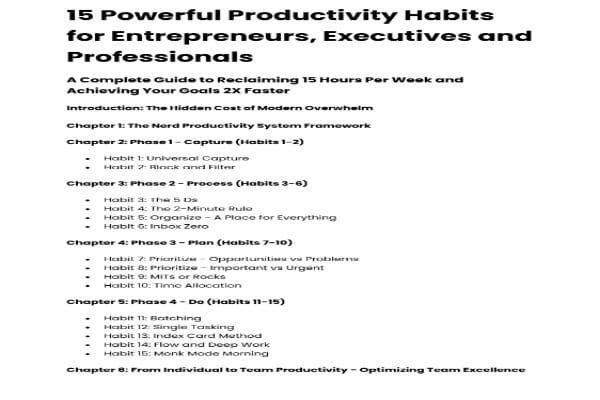
Ready to build your productivity foundation on solid principles rather than random techniques? Download the 15 Productivity Habits Guide to see exactly how these fundamental rules integrate into a unified system for managing your day-to-day work and life with maximum effectiveness and minimum stress.