
The Eisenhower Matrix tells you what matters. It does not tell you what gets done this week. That is the gap most business owners fall into — they know their Q2 priorities, and those priorities still slip to next week, and the week after that.
Habit 9 in the NP System closes that gap. It is called the Rocks and MITs method, and it has one job: turn your most important work into named, committed weekly deliverables before the week starts.
Rocks are not tasks. A task is “work on the strategy deck.” A Rock is “send the revised strategy deck to the investor by Thursday 5pm.” One is an intention. The other is a deliverable with a specific done state you can verify on Friday.
This post walks through exactly how to set your weekly Rocks using the NP System — and why most business owners skip this step and spend another week firefighting instead.
What Are Rocks in the NP System?
The term comes from Stephen Covey’s “big rocks first” idea: if you do not put the big rocks in the jar first, the small stones fill the space and the big rocks never fit.
In the NP System, a Rock is a named weekly deliverable — the one thing per active project that MUST move this week. Not a task list. Not a focus area. A specific deliverable with a done state you can verify by Friday.
MITs (Most Important Tasks) operate on a daily scale. Each morning, you look at your weekly Rocks and ask one question: which one can I move most today? That becomes your MIT for the day — the first thing you protect before the inbox opens, before the first meeting starts.
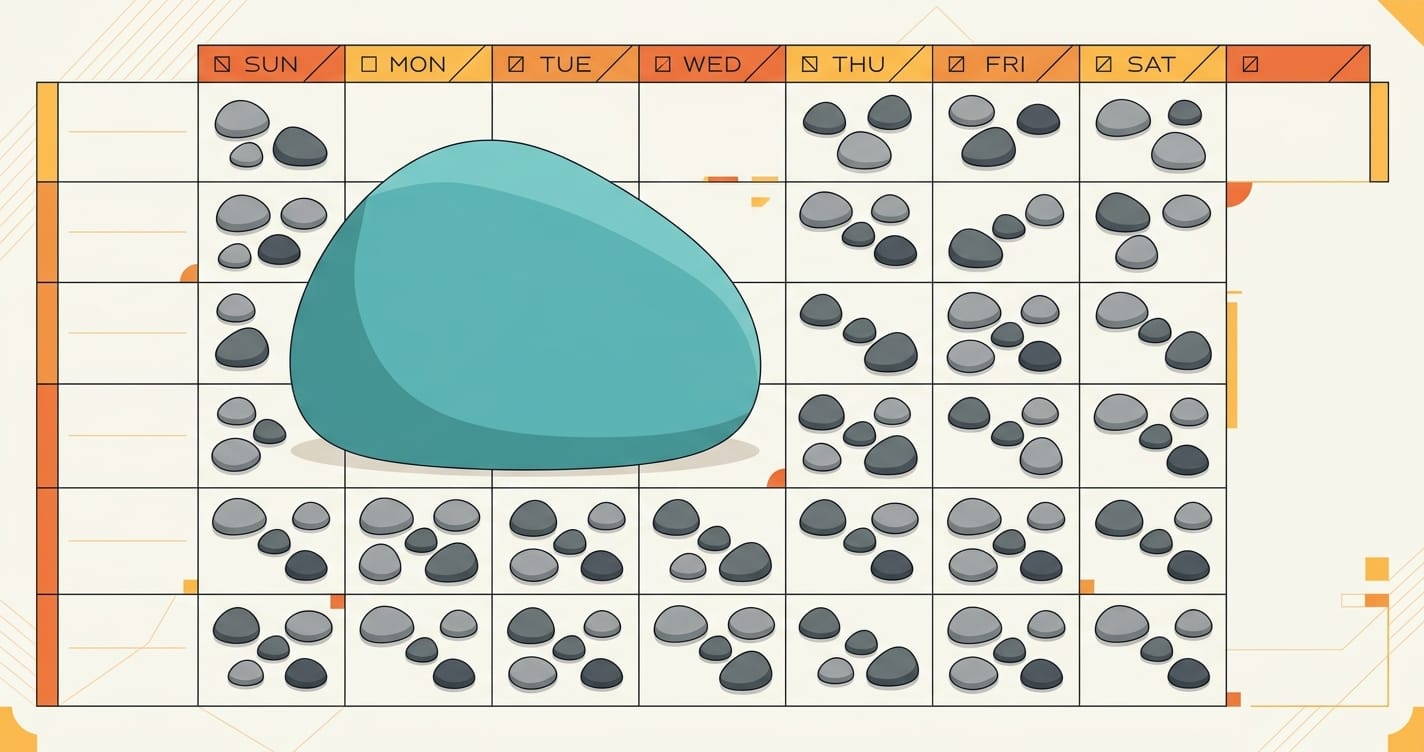
The difference between a Rock and a task is commitment. Tasks live on a list. Rocks go into your calendar as protected time before anything else gets scheduled.
Why Q2 Work Always Slips (and What Changes It)
If you have worked through Habit 7 and the Eisenhower Matrix in Habit 8, you know what is in Q2 — the important work with no hard external deadline. Strategic planning. The investor conversation you have been meaning to have. The content strategy. The process you need to document so you can delegate it.
Q2 work is exactly what moves the business forward. It is also exactly what business owners tell themselves they will get to next week — and next week arrives and goes.
The reason is not discipline. It is structural. Q2 items have no external claim on your time. A client deadline has a claim. A meeting has a claim. “Do the strategic review” has no claim — so when a Q1 fire erupts on Tuesday morning, the strategic review moves.
Naming a Rock gives Q2 work the same structural claim as a meeting. Once it has a specific done state and a time block, it stops being an intention and becomes a commitment.
How to Set Your Weekly Rocks
This takes fifteen minutes. It happens after the proactive planning review from Habit 7 and the Eisenhower sort from Habit 8. Sunday evening or Monday morning both work — before the week’s reactive load kicks in.
Step 1: Name one Rock per active project
Look at your Q2 work across every active project. For each one, identify the single deliverable that must move this week — not the most ambitious one, but the one that unlocks the next step. If you have five active projects, you have five potential Rocks. A realistic week carries one to three. Pick the ones that matter most and move the rest to your next weekly review.
Step 2: Write each Rock as a done state, not an intention
Wrong: “Work on the pitch deck.”
Right: “Send the revised pitch deck to the investor by Thursday 5pm.”
The done state is what you can verify. If you cannot write a done state, the Rock is not clear enough yet — keep refining until it is.
Step 3: Block the time before anything else
Rocks go into the calendar before meetings, before admin, before the inbox. Monday morning is not the time to find a gap — by then the gap is already gone. Time allocation (Habit 10) is the next step in the NP System precisely because Rocks without protected time are still just intentions with better names.
Step 4: Set your MIT each morning from your weekly Rocks
Each morning, look at your weekly Rocks and ask: which one can I move the most today? That is your Most Important Task. Work on it before the inbox, before any messages, before any reactive pull. The MIT connects directly to single-tasking (Habit 11) and the Monk Mode Morning (Habit 15) later in the NP System — for now, the rule is simple: one task, start there.
Where Rocks Fit in the NP System Plan Phase
The Plan phase runs four habits in sequence:
- Habit 7 — Reactive vs proactive planning: Identify the gap between firefighting and strategic work, and commit time to both every week.
- Habit 8 — Eisenhower Matrix: Sort your work into the four quadrants. Find what is genuinely Q2.
- Habit 9 — Weekly Rocks and MITs: Turn Q2 priorities into named weekly deliverables with done states and protected time. (This post.)
- Habit 10 — Time allocation: Build a weekly schedule where your Rocks have guaranteed slots, not just good intentions.
Rocks are the output of the Eisenhower. They answer the question: of all my Q2 work, what is the one deliverable per project that gets done this week? Time allocation (Habit 10) answers: when exactly does it happen, and what gets moved to make room?
The Plan phase sits between Process (Habits 3–6) and Do (Habits 11–15) in the full NP System. Process clears the noise. Plan decides what matters. Do protects the time and ships the work.
Making Rocks Stick: Common Failure Modes
Three patterns kill Rocks before the week is out.
Too many Rocks. If you set six Rocks, you have set none. You cannot protect time for six deliverables in a business week that already has meetings, clients, and reactive work. Cut to three maximum, and hold that limit.
Rocks without done states. “Progress on the proposal” is not a Rock. It has no verification point. You can spend eight hours on it and not know whether you have done it. Write the done state before the week starts, or the Rock will slide.
Rocks with no time in the calendar. A Rock on a list is a wish. A Rock in the calendar with a time block is a commitment. Block the time as the first scheduling action of the week, before anyone books a meeting in that slot.
Starting This Week
Open your task manager or a blank document. List your active projects. For each one, name the one deliverable that must happen before Friday — specific enough that you can verify it by end of day Friday. Add a deadline. Then block the time in your calendar before you do anything else.
That is Habit 9. One Rock per project. A done state. Protected time. Reviewed each morning as your MIT.
The broader NP System — all 15 habits across Capture, Process, Plan, and Do — is available as a free course here. If you want to find out which phase your current system is weakest in, the Productivity Quiz takes three minutes.
Frequently Asked Questions
What are Rocks in productivity?
In the NP System and Franklin Covey’s framework, Rocks are your one to three most important weekly deliverables — not task lists, but named outcomes with a specific done state and a deadline. The term comes from the ‘big rocks first’ jar analogy: if you do not schedule your most important work before everything else, smaller tasks and reactive work fill the time and the strategic work never happens.
How many Rocks should I set per week?
One to three. More than three and you cannot realistically protect time for all of them across a working week. One Rock per active project is a practical guide — if you have four live projects, pick the single deliverable per project that absolutely must move this week and put the rest into next week’s review.
What is a MIT (Most Important Task)?
An MIT is the daily version of a Rock. Each morning, you look at your weekly Rocks and ask which one you can move the most today. That task becomes your Most Important Task — the work you start before the inbox, before messages, before any reactive pull begins.
How do Rocks fit into the NP System Plan phase?
Rocks are Habit 9 in the NP System’s Plan phase, which runs four habits in sequence. Habit 7 builds the proactive planning habit. Habit 8 (Eisenhower Matrix) identifies your Q2 priorities. Habit 9 turns those priorities into named weekly deliverables. Habit 10 (time allocation) protects time for them in your calendar before anything else is scheduled.
What happens if I do not finish a Rock this week?
Review it at the start of next week’s planning session. If it is still the most important deliverable for that project, it carries forward as next week’s Rock with a new deadline. If something more urgent emerged, the unfinished Rock moves to your Someday/Maybe list or gets rescheduled. The important step is the review — unreviewed Rocks accumulate and make the whole system feel heavier than it is.
