
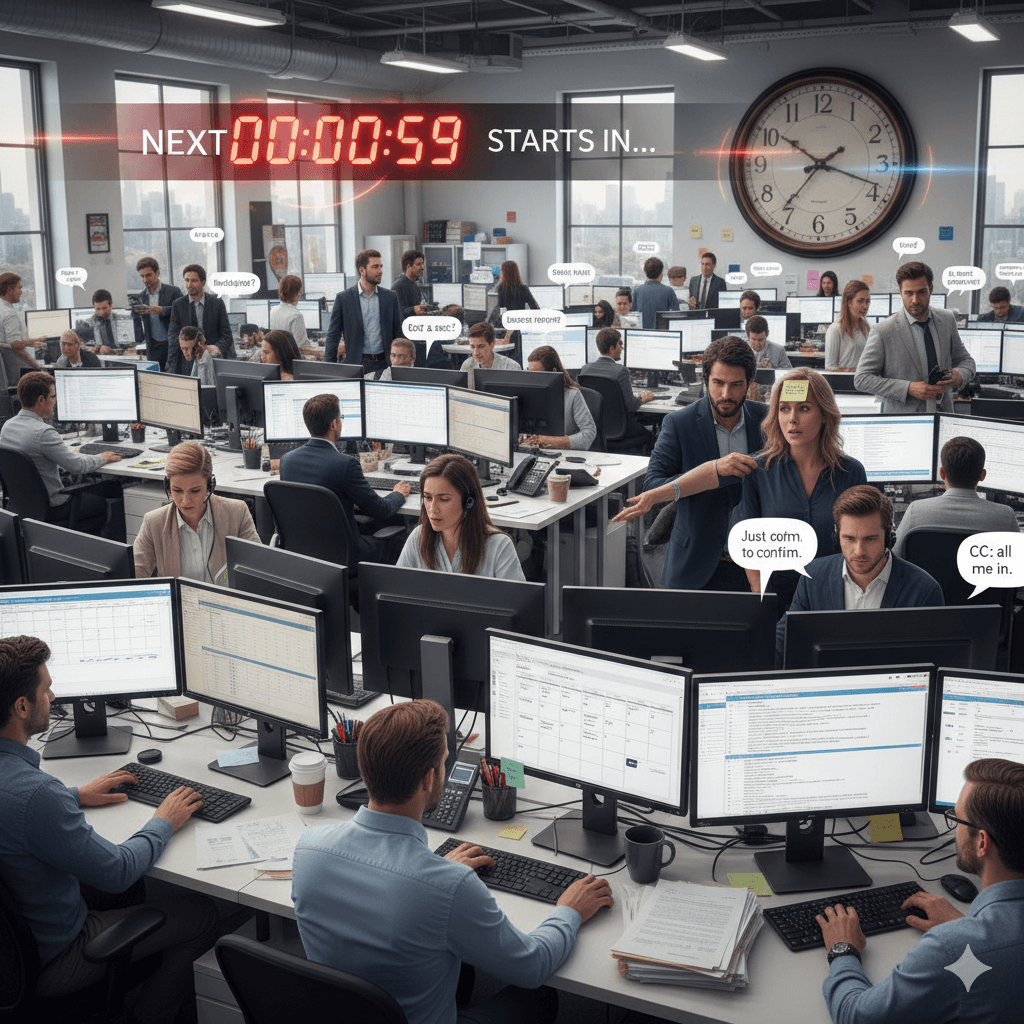
Your colleague sends a “quick question” via Slack whilst you’re mid-sentence in a complex document. Before you can respond, another message arrives. Then an email notification. Then a calendar reminder about the meeting starting in five minutes—the one scheduled to discuss the meeting you had yesterday.
You close your laptop and head to the conference room, where you’ll spend the next hour discussing project status that could have been communicated in a three-sentence email. After the meeting, you return to your desk to find 17 new messages, three meeting invitations, and zero progress on the strategic work that actually matters.
By day’s end, you’ve been extraordinarily busy yet accomplished nothing of substance. You’ve attended meetings, responded to messages, and appeared productive. But the important work—the projects that would actually move the business forward—remains untouched.
This pattern isn’t unique to your organisation. It’s endemic across modern workplaces, creating a productivity crisis that AI cannot solve because the problem isn’t capability—it’s systematic dysfunction in how we organise work itself.
The AI Displacement Myth
Concerns about AI eliminating office jobs assume that organisations currently operate with reasonable efficiency. They don’t.
The Efficiency Assumption
Predictions about AI displacement rest on the premise that companies employ the minimum necessary people to accomplish required work. If this were true, AI’s productivity gains would indeed reduce headcount requirements.
However, most organisations employ substantially more people than necessary—not because they’re poorly managed, but because dysfunctional workplace practices create artificial work that consumes available capacity.
The Hidden Inefficiency
When constant interruptions prevent focused work, tasks take three times longer than necessary. When meetings fill calendars, actual execution gets pushed to evenings and weekends. When communication overhead consumes half of each day, you need twice as many people to accomplish the same output.
These inefficiencies remain invisible because everyone experiences them. When the entire organisation operates at 30% of potential productivity, that becomes the baseline against which performance is measured.
The AI Paradox
AI tools can make individuals more productive, but they cannot fix the systematic dysfunction that prevents organisations from leveraging that productivity. You can use AI to draft documents faster, but if those documents get lost in endless review cycles and meeting discussions, the efficiency gains disappear.
The Thirteen Dysfunction Patterns
Specific workplace practices systematically destroy productivity whilst creating the appearance of necessary work.
Pattern 1: Constant Interruption Culture
Interrupting colleagues every 30 seconds with “quick questions” fragments attention and prevents the sustained focus necessary for complex work. Each interruption creates a cognitive switching cost that compounds throughout the day.
Research shows it takes an average of 23 minutes to fully refocus after an interruption. When interruptions occur every few minutes, people never achieve the deep focus where their best work happens.
Pattern 2: Instant Response Expectations
Expecting immediate responses to every Slack message and email creates a culture of constant availability that makes focused work impossible. People remain in reactive mode, responding to whatever arrives rather than working strategically on important projects.
This expectation also creates inequality, rewarding those who sacrifice depth for speed whilst punishing those who protect focus time for quality work.
Pattern 3: Calendar Saturation
Scheduling entire days with back-to-back meetings leaves zero time for the actual work discussed in those meetings. Teams spend hours coordinating, planning, and updating without executing.
The work that requires focused attention—analysis, creation, problem-solving—gets pushed to evenings and weekends, creating unsustainable patterns.
Pattern 4: deep work Elimination
Leaving no time for actual deep work between status updates guarantees that complex thinking never happens. Strategic planning, creative problem-solving, and innovation all require sustained concentration that fragmented schedules cannot provide.
Pattern 5: Meeting Proliferation
Filling calendars with meetings that should have been emails wastes collective time whilst creating the illusion of productivity. Many meetings exist to coordinate work that poor systems make unnecessarily complicated.
Pattern 6: Performative Presence
Forcing peak-hour commutes so people can sit on Zoom calls from the office demonstrates that presence matters more than output. This wastes commute time whilst failing to leverage the collaboration benefits that justify office presence.
Pattern 7: Work About Work
Creating work about work—meetings to prepare for meetings, status updates about status updates—multiplies coordination overhead without advancing actual objectives. Administrative tasks consume the capacity needed for value creation.
Pattern 8: Strategy-Execution Disconnect
Never explaining how daily tasks connect to company priorities leaves people working hard on activities that don’t advance strategic objectives. Effort feels wasted because the connection between action and outcome remains invisible.
Pattern 9: Direction Instability
Changing direction weekly without context creates confusion and rework. Teams invest effort in initiatives that get abandoned, then scramble to catch up on the new priority, never building momentum on anything.
Pattern 10: Capacity-Blind Assignment
Assigning work via chat with zero regard for current capacity or deadlines guarantees overcommitment. Teams already working at full capacity cannot absorb additional work without something suffering—usually quality, deadlines, or both.
Pattern 11: Presence-Output Confusion
Expecting people to respond to emails and attend meetings whilst somehow also “getting real work done” creates impossible expectations. Execution work and coordination work require different conditions and cannot happen simultaneously.
Pattern 12: Presence Metrics
Measuring presence over output rewards appearing busy rather than accomplishing meaningful work. This encourages visible activity—meetings, emails, chat messages—over invisible value creation like deep thinking and strategic work.
Pattern 13: Busyness Worship
Rewarding whoever looks busiest rather than who delivers results creates incentives for performative productivity. People optimise for appearing overwhelmed rather than for actual effectiveness.
The Productivity Paradox
These dysfunction patterns create a paradox: organisations need more people than necessary because systematic inefficiency prevents existing teams from operating anywhere near their potential.
The Capacity Illusion
When dysfunction reduces effective productivity to 30% of potential, you need more than three times as many people to accomplish the same work. This isn’t about individual capability—it’s about systematic barriers preventing people from applying their capabilities effectively.
The Invisible Waste
Because everyone experiences the same dysfunction, it becomes normalised. Nobody questions whether constant meetings are necessary because everyone’s calendar looks the same. Nobody challenges instant response expectations because everyone operates that way.
The waste remains invisible because it’s universal.
The AI Immunity
AI cannot fix these problems because they’re not capability issues—they’re systematic dysfunction in how work is organised, communicated, and coordinated. Making individuals more productive through AI tools doesn’t help if the organisational systems waste that productivity through meetings, interruptions, and coordination overhead.
The Real Threat to Employment
If AI won’t eliminate office jobs, what will? The answer is organisations that fix the dysfunction patterns whilst competitors don’t.
The Efficiency Advantage
Companies that eliminate unnecessary meetings, protect focus time, clarify strategy-execution connections, and measure output over presence can accomplish the same work with substantially fewer people—or accomplish substantially more with the same people.
This efficiency advantage compounds over time. Better execution leads to better results. Better results attract better talent. Better talent amplifies the efficiency advantage.
The Competitive Divergence
As some organisations fix dysfunction whilst others don’t, productivity gaps widen. The efficient organisations can outcompete on price, quality, innovation, or all three simultaneously.
The Employment Impact
This divergence, not AI capability, will drive employment changes. Organisations that continue operating with systematic dysfunction will struggle to compete with those that don’t, regardless of AI adoption.
The Path to Functional Productivity
Fixing workplace dysfunction requires systematic changes across multiple dimensions rather than individual behaviour modification.
Communication Protocols
Establish clear guidelines about when to use different communication channels. Asynchronous communication for routine updates. Scheduled meetings for collaboration. Real-time chat reserved for genuinely urgent issues.
Meeting Discipline
Implement policies that protect execution time from coordination overhead. Meeting-free days or blocks. Required agendas and outcomes. Standing meetings regularly evaluated for continued necessity.
Focus Protection
Create cultural norms that protect deep work time. Respect for “do not disturb” status. Scheduled focus blocks treated as seriously as meetings. Expectation that complex work requires uninterrupted time.
Capacity Management
Implement systems for tracking current commitments before assigning new work. Transparent workload visibility. Explicit prioritisation when capacity is exceeded. Permission to say no to work that doesn’t fit current capacity.
Output-Based Evaluation
Shift from presence-based to results-based performance measurement. Clear objectives and success criteria. Progress tracking focused on outcomes rather than activity. Recognition for impact rather than busyness.
Your Organisation’s Assessment
Does your workplace exhibit these dysfunction patterns? If so, you’re operating at a fraction of potential productivity—and AI adoption won’t fix that.
The question isn’t whether AI will eliminate your job. It’s whether your organisation will fix the systematic dysfunction that prevents people from working effectively, or whether competitors will fix it first and gain insurmountable advantages.
Individual productivity improvements help, but they cannot overcome organisational dysfunction. When the system wastes productivity as fast as individuals create it, everyone works harder whilst accomplishing less.
The transformation requires systematic changes to how work is organised, communicated, and coordinated—changes that enable people to apply their capabilities effectively rather than wasting them on dysfunction.
Ready to discover which dysfunction patterns are affecting your team’s productivity and get specific recommendations for fixing them? The Team Productivity Assessment reveals exactly where systematic dysfunction is preventing your team from operating at potential, plus actionable strategies for implementing the communication protocols, meeting discipline, focus protection, and capacity management that enable people to do their best work without the constant interruptions, coordination overhead, and preformative busyness that currently waste their capabilities.