
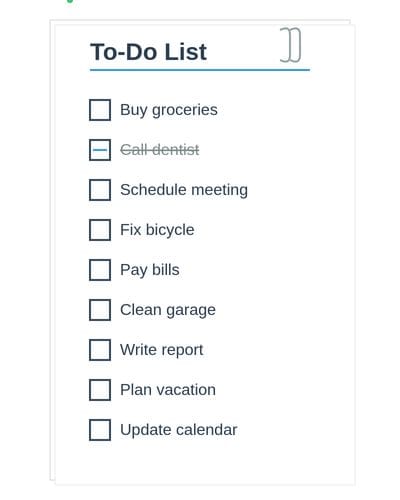
You open your task manager at 9 AM and see 37 items staring back at you. “Call dentist” sits beside “Develop Q4 strategy.” “Buy milk” appears next to “Prepare board presentation.” Your stomach tightens as you scroll through the overwhelming mixture of trivial errands and career-defining projects.
Twenty minutes later, you’re still deciding where to start. The strategic work feels too big. The small tasks feel too trivial. Everything seems equally urgent and equally impossible. You close the app and check email instead, telling yourself you’ll come back to the list once you’ve cleared your inbox.
By day’s end, you’ve worked hard on urgent issues that weren’t even on your list. The 37 items remain largely untouched, now joined by 12 new ones. You feel simultaneously exhausted and unproductive, busy yet ineffective.
The problem isn’t your discipline or time management. Your to-do list itself is sabotaging your productivity.
Capture List Masquerade
What you think of as your to-do list is actually just a capture list—a mental dump of everything occupying headspace on any given day. This distinction matters enormously.
A capture list serves one purpose: getting thoughts out of your head and into an external system. It’s the first step in productivity, not the final one. Treating it as a to-do list—a guide for execution—creates predictable problems.
Imagine trying to cook directly from a grocery list without a recipe. You have ingredients but no method, no sequence, no clarity about what you’re actually making. That’s what happens when you try to work directly from a capture list.
The capture function is valuable. Your brain performs poorly as a storage device, and externalising commitments frees mental bandwidth for thinking and execution. But capture without processing creates a different problem: overwhelming, unusable lists that paralyse rather than enable action.
Overwhelm Engine
Long, unprocessed lists trigger psychological responses that actively prevent productive work.
Decision Fatigue and Analysis Paralysis
When faced with 37 undifferentiated items, your brain must evaluate each one to determine what deserves attention. This evaluation consumes cognitive resources before you’ve accomplished any actual work.
Research shows that decision-making depletes mental energy. Each choice—even small ones—reduces your capacity for subsequent decisions. When your first task of the day is choosing from dozens of options, you’ve exhausted decision-making capacity before starting meaningful work.
This decision fatigue often leads to procrastination. When choosing feels overwhelming, avoiding the choice altogether provides temporary relief. You end up checking email, scrolling social media, or handling whatever urgent request arrives—anything to escape the paralysis of too many options.
Stress and Anxiety Amplification
Long lists create visual and psychological pressure. Your brain sees 37 items and interprets this as 37 obligations you’re failing to meet. The list becomes a constant reminder of incompleteness rather than a tool for progress.
This anxiety intensifies throughout the day. As evening approaches and you realise you’ve barely touched your list, stress compounds. You feel behind, inadequate, overwhelmed—emotions that further impair your ability to think clearly and work effectively.
The irony is that much of this stress stems from items that don’t actually need completion today, or perhaps ever. But undifferentiated lists don’t communicate this nuance. Everything appears equally urgent, creating artificial pressure.
Vague Task Problem
Beyond overwhelming quantity, typical to-do lists suffer from vague, unactionable items that create friction when you try to execute.
Ambiguous Next Steps
“Handle client situation” appears on your list. What does that mean? Call the client? Review their file? Draft a proposal? Consult with your team? The ambiguity creates a micro-decision point every time you encounter the item.
These micro-decisions accumulate into significant overhead. Each vague task requires you to stop, think, clarify, and plan before you can even begin. This friction makes starting difficult, which encourages procrastination.
Missing Context and Complexity
Some list items hide substantial complexity. “Prepare presentation” might represent 10 hours of work across research, design, rehearsal, and refinement. When it appears as a single line item, it feels simultaneously too big to start and too simple to deserve serious attention.
This mismatch between perception and reality creates planning failures. You allocate 30 minutes for “prepare presentation,” discover it requires much more, and end up frustrated and behind schedule.
False Productivity Trap
To-do lists encourage a quantity-over-quality mindset that undermines genuine effectiveness.
Completion Addiction
Checking items off lists provides psychological satisfaction through small dopamine releases. This reward system can become addictive, leading you to prioritise quick completions over important work.
You find yourself choosing easy tasks—responding to routine emails, handling minor administrative items—because they provide the satisfaction of completion. Meanwhile, strategic projects that would create real value remain untouched because they can’t be “completed” in a single session.
This pattern creates the illusion of productivity. You’re busy, you’re completing tasks, your list is shrinking. Yet you’re not making meaningful progress on objectives that actually matter for your career, business, or life goals.
Urgent Versus Important Confusion
Without proper organisation and prioritisation, to-do lists treat all items as equally deserving of attention. The urgent crowds out the important. The squeaky wheel gets the grease whilst strategic priorities languish.
This happens partly because urgent items create more psychological pressure. A looming deadline generates anxiety that feels like importance. Meanwhile, genuinely important work without artificial urgency—relationship building, skill development, strategic planning—feels less pressing despite creating more long-term value.
Planned Versus Unplanned Tension
Real work rarely follows predetermined plans. Most days involve substantial unplanned work that wasn’t on any list.
Reality of Emergent Work
Client emergencies arise. Colleagues need urgent input. Opportunities appear unexpectedly. This unplanned work often is genuinely important and appropriately claims your attention.
However, when your productivity system assumes you’ll simply execute a predetermined list, unplanned work creates frustration and feelings of failure. You end the day having accomplished important things yet feeling unproductive because those things weren’t on your list.
Flexibility Paradox
Rigid adherence to predetermined lists can cause you to miss important opportunities or fail to respond appropriately to changing circumstances. Yet complete flexibility leads to reactive chaos where you’re constantly responding to whatever demands immediate attention.
Effective productivity requires balancing planned work with adaptive capacity. Traditional to-do lists don’t accommodate this balance—they assume complete control over your schedule and priorities.
Missing Context Problem
Perhaps the most fundamental flaw in typical to-do lists is their complete lack of context.
Incomparable Items
“Buy milk” and “develop Q4 strategy” shouldn’t exist in the same evaluation space. They require different mental states, different time commitments, different energy levels, and different environments. Comparing them directly makes priority decisions artificially difficult.
When your list mixes personal errands with professional projects, family responsibilities with business development, and quick tasks with complex initiatives, you can’t meaningfully prioritise. You’re comparing apples to bicycles.
Context Switching Overhead
Working from a mixed-context list guarantees constant context switching. You handle a work email, then remember you need groceries, then start on a strategic project, then respond to a family scheduling question.
Each switch carries a cognitive cost. Research shows it takes an average of 23 minutes to fully refocus after an interruption. When your task list itself creates these interruptions by mixing contexts, you never achieve the sustained focus necessary for complex work.
Three-Step Transformation
Moving from overwhelming capture lists to productive action systems requires three distinct steps.
Step 1: Accept the Planning-Reality Gap
Stop expecting to complete everything on your list each day. This expectation creates unnecessary stress and sets you up for feelings of failure.
Instead, recognise that each day involves both planned work (items you’ve intentionally chosen to focus on) and emergent work (important issues that arise unexpectedly). Both are legitimate. Both deserve attention. Neither should create guilt.
In fact, leaving buffer capacity for emergent work is wise planning, not poor execution. When you’re scheduled at 100% capacity, any unexpected issue creates a crisis. Building in slack creates resilience and adaptability.
Step 2: Organise by Context and Category
Transform your single overwhelming list into context-specific lists that group similar work together.
Create separate lists for:
- Work projects and professional responsibilities
- Home management and family logistics
- Personal development and health goals
- Financial planning and administration
- Social connections and relationship maintenance
Within each context, you might further categorise by factors like:
- Energy level required (high focus vs. routine)
- Time commitment (quick tasks vs. extended projects)
- Location or tool requirements (computer work vs. errands)
This organisation enables meaningful prioritisation. Within the “work projects” context, you can rationally compare different professional priorities. Within “home management,” you can sensibly prioritise household tasks. But you’re no longer trying to compare incomparable items across completely different life domains.
Context-based organisation also reduces switching costs. When you’re working in the “professional” context, everything on your screen relates to that role. Your brain can settle into the appropriate mental mode rather than constantly shifting gears.
Step 3: Rewrite for Clarity and Action
Transform each vague list item into a clear, specific, actionable task—as if you were delegating it to someone else who needs explicit direction.
Vague: “Handle client situation” Clear: “Call John at ABC Corp to discuss the contract delay. Review file first to understand timeline and commitments.”
Vague: “Prepare presentation” Clear: “Draft outline for Q4 strategy presentation covering three scenarios. Aim for 15 slides, focus on financial implications.”
Vague: “Exercise more” Clear: “Schedule three 30-minute morning walks this week—Monday, Wednesday, Friday at 7 AM.”
This rewriting process often reveals that single items actually represent multiple tasks. “Prepare presentation” becomes research, outlining, drafting, designing, rehearsing, and refining. Breaking complex work into specific steps makes it less overwhelming and easier to start.
The clarity also eliminates friction. When you’re ready to work, you don’t need to spend mental energy figuring out what the task actually means. The next action is explicit, reducing the activation energy required to begin.
Productivity-Clarity Connection
Clarity might be more than 50% of productivity. When you know exactly what needs doing, in what context, with what priority, starting becomes natural rather than forced.
Vague, overwhelming lists create internal resistance. Your brain sees the list and experiences decision fatigue, anxiety, and confusion. This resistance manifests as procrastination, distraction, and avoidance.
Clear, organised, context-specific lists reduce this resistance dramatically. Your brain sees focused options within a relevant context and can quickly identify appropriate work. The friction disappears, and productivity flows.
This transformation doesn’t require new apps or complex systems. It requires processing your capture list through organisation and clarification before you try to execute from it.
Your Productivity System Evolution
The shift from capture list to action system represents a fundamental evolution in how you approach productivity.
Capture remains important—getting commitments out of your head frees mental bandwidth and prevents forgotten tasks. But capture is just the first step, not the complete system.
Processing captured items into organised, clarified, context-specific action lists transforms productivity from overwhelming to manageable. You move from reactive chaos to intentional focus.
This evolution requires building new habits around regular processing. Daily or weekly sessions where you review captured items, categorise them by context, clarify vague tasks into specific actions, and identify genuine priorities.
The time invested in processing pays enormous dividends in execution. Twenty minutes of thoughtful organisation can save hours of decision fatigue, false starts, and scattered attention.
Ready to transform your overwhelming capture list into a clarity-driven productivity system that actually helps you accomplish what matters? The Productivity Quiz reveals exactly where your current approach creates friction and provides personalised strategies for building the organisation, clarity, and context-based systems that enable focused execution without the overwhelm and anxiety of traditional to-do lists.