
The Rocks method (Habit 9) tells you what matters most this week. You name the deliverable, write the done state, and commit to three at most. And then Monday arrives and the calendar fills up before you touch any of them.
The meeting at 9am. The client call at 11am. A lunch that runs long. By Thursday afternoon the Rock has been pushed again, and this week ends the same way last week did.
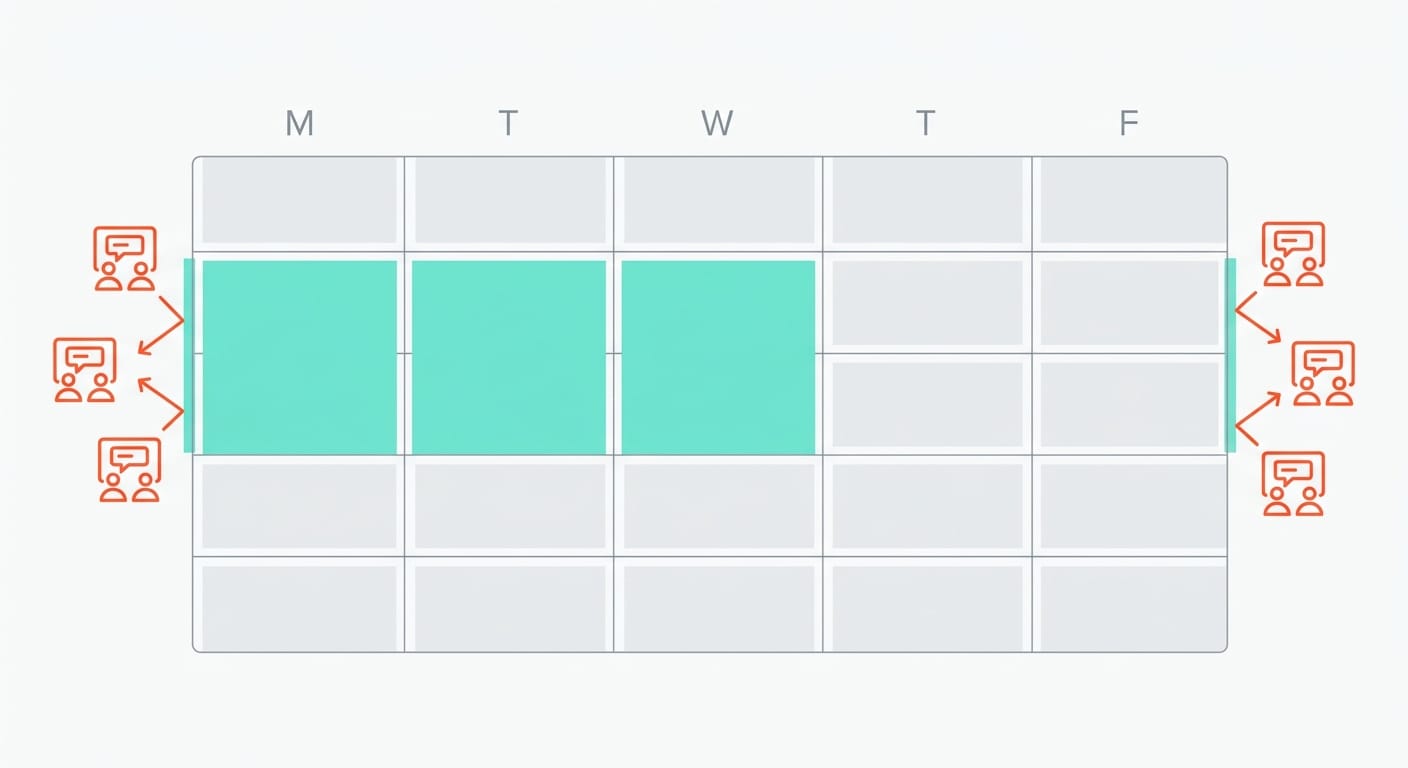
Habit 10 fixes this. Time allocation is the act of putting your Rocks into the calendar before anything else gets scheduled — not as vague intentions but as named, protected blocks with the same structural claim on your day as a meeting.
It is the final habit in the Plan phase, and it is where the four Plan-phase habits complete the loop: you have cleared the reactive noise, sorted by importance, named what matters most, and now you protect when it happens.
What Time Allocation Means in the NP System
Most time management advice treats allocation as “schedule everything.” It becomes an exercise in filling every hour, which fails immediately when a client call runs over or a deliverable takes longer than the block allowed.
The NP System takes a narrower view. Time allocation has one specific job: protect a named, bounded slot for each Rock before the week’s reactive load fills the calendar.
Not scheduling every task. Not time-boxing email or admin. Just ensuring each Rock has a block it can live in, set before Monday morning arrives.
A Rock without a time block is still an intention. Once it has a block — a specific time on a specific day, protected before any meeting is booked — it becomes a commitment. The calendar is the last gate between planning and execution.
Why Business Owners Get This Wrong
The natural scheduling pattern for most business owners runs in reverse. Meetings get booked first — client calls, team syncs, check-ins, a lunch. Deep work fills whatever gap remains.
The problem is that gaps left after meetings are rarely long enough for a Rock. Strategic work typically needs ninety minutes to two hours of uninterrupted focus. What the leftover calendar provides is thirty-minute fragments between obligations.
The result is the familiar situation: a Rock lands on the list Sunday evening, carries forward as a named priority all week, and still has not moved by Friday. Not because it was deprioritised — because no time was held specifically for it.
Habit 10 reverses the sequence. Rocks go into the calendar first, before any discretionary meeting. This is not anti-social — it is the minimum protection that Q2 work requires to actually happen.
How to Allocate Time with the NP System
The rule is simple: one protected block per Rock, scheduled before the week’s reactive load starts.
Set three deep work blocks per week
At the start of the week — Sunday evening or Monday morning before the inbox opens — block three deep work sessions of ninety minutes each. These are not labelled “miscellaneous” or “deep work.” Each one belongs to a specific Rock, with its name and done state written into the block title. If you have two Rocks, two blocks are claimed and the third stays open as a flex session.
Schedule the blocks before discretionary meetings
Any meeting that does not require you on a specific date — a catch-up, a working session, a planning call — gets scheduled around the Rock blocks, not before them. Client-required meetings and hard external deadlines take priority; everything else moves.
Protect the blocks from yourself
The most common override is not a client request. It is your own willingness to fill a quiet morning with something that feels productive — a proposal refinement, an email that could wait, a message thread that did not need attention. The block’s job is to hold that space. Your job is to treat it as non-negotiable as a client call.
Where Time Allocation Fits in the NP System Plan Phase
The Plan phase runs four habits in sequence:
- Habit 7 — Reactive vs proactive planning: Commit time to both reactive and strategic work before the week starts.
- Habit 8 — Eisenhower Matrix: Sort all open work into the four quadrants. Identify what is genuinely Q2.
- Habit 9 — Weekly Rocks and MITs: Turn Q2 priorities into named weekly deliverables with done states and deadlines.
- Habit 10 — Time allocation: Protect when each Rock happens before anything else claims the slot. (This post.)
The sequence matters. You cannot allocate time well until you have named the Rocks (Habit 9), and you cannot name the Rocks effectively until you have sorted by importance (Habit 8), and that sort only works once you have separated reactive from strategic (Habit 7).
Time allocation completes the Plan phase. The Do phase (Habits 11–15) — single-tasking, flow state, the Monk Mode Morning — protects execution inside each block. The broader NP System shows how all four phases connect.
Common Failure Modes
Three patterns break time allocation before the week is out.
Blocks scheduled too short. A Rock that needs ninety minutes cannot be completed in a forty-five-minute slot. Underestimating the time sets up a partial completion and a carry-over, not a finished deliverable.
Blocks at the wrong energy level. If your clearest thinking happens before 11am, a Rock block at 4pm is a structural mismatch. Match block timing to your actual energy pattern, not just to whatever calendar slot happens to be free.
Blocks treated as suggestions. Something will ask you to move a Rock block every week — a meeting request, an urgent-seeming message, your own impulse to do something easier. The block exists precisely to resist that pressure. The default answer is no.
Starting This Week
Open your calendar now, before the week starts. Find three ninety-minute windows at your best energy times. Assign one Rock to each block. Write the Rock’s name and done state directly in the block title — not “deep work” but the specific deliverable with its deadline.
Then protect those slots from everything else until Friday.
The block is in the calendar. The Rock is named. The Plan phase is complete.
The full NP System — all 15 habits across Capture, Process, Plan, and Do — is available as a free course here. If you want to find out which phase your current system is weakest in, the Productivity Quiz takes three minutes.
