
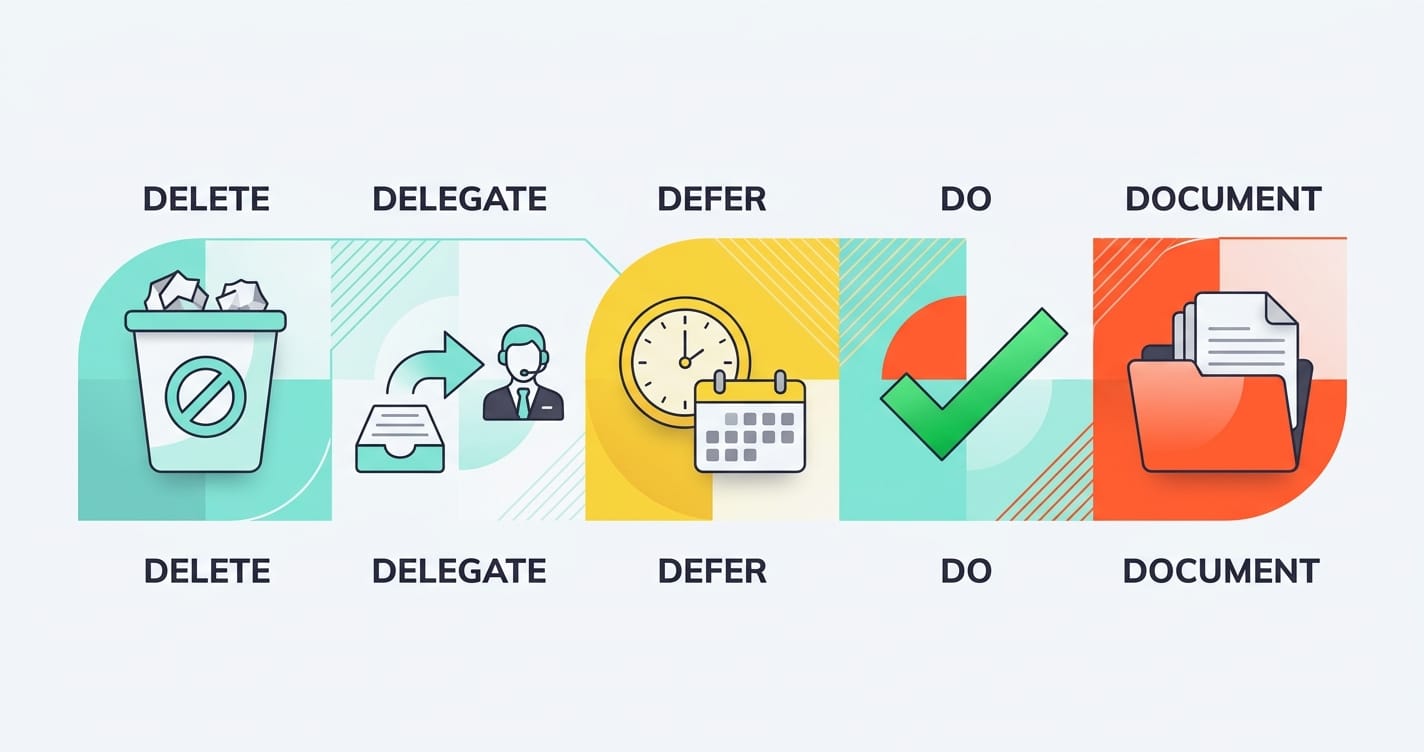
The 5 Ds of productivity is a triage method for processing any incoming task, email, or decision: Delete it, Delegate it, Defer it, Do it, or Document it. Each item gets exactly one of these five outcomes, which means nothing sits in an undecided state.
For business owners running several concurrent projects, the triage step is where systems either hold or collapse. Without a clear process for what to do with each incoming item, work accumulates in inboxes, apps, and notebooks — half-addressed, never quite resolved. The 5 Ds give that process a structure.
Where the 5 Ds come from
The 5 Ds pattern draws from two overlapping frameworks: David Allen’s Getting Things Done and classic inbox-management practice. Allen’s core decision is “do it, delegate it, defer it, or drop it” — the 5 Ds version adds a fifth category to close one common gap: the difference between a task you are genuinely deferring and one you are silently letting pile up.
That distinction is what makes the method usable rather than aspirational.
The five outcomes, defined
Delete
The most underused option. Before anything else, ask whether this item actually matters. A large share of email, notifications, and requests answer “no”. Delete it, archive it, unsubscribe from it. Letting these items survive into your triage queue is the first way the system breaks down.
The test is straightforward: what is the worst realistic outcome if you never act on this? If the answer is nothing significant, delete it.
Delegate
If the item needs to happen but does not require you specifically, assign it to someone with the authority and information to handle it. The delegation is complete when two things are true: the other person has accepted it, and you have a follow-up mechanism so it does not disappear.
Forwarding an email and hoping someone acts is not delegation. Delegation requires a named owner, a clear scope, and a date. The universal capture system is where delegated items sit until they resolve.
Defer
Defer means the item has a real next action but cannot be completed now. It goes into your task system with a date — a due date if it is time-sensitive, or a scheduled review date if not. The critical rule: defer is not a holding area. Everything deferred must carry a next action and a date.
This is where most informal triage fails. “I’ll deal with it later” without a specific later is avoidance with extra steps. The GTD two-minute rule is a useful gate here: if you can handle the item in under two minutes, do it now before it becomes a defer.
Do
If the item requires your attention and takes under two minutes, do it immediately. Anything longer should be deferred with a proper next action — context-switching during triage adds hidden time cost and degrades the quality of the work.
The “Do” category works best when you reserve it for genuinely short items. If you find yourself regularly spending fifteen minutes on items you classify as “Do”, you are conflating triage with execution. They are separate phases.
Document
Some items are not tasks — they are information. Reference material, decisions taken in a meeting, a client preference, a useful link. These need to be stored somewhere retrievable, not left in an email thread or a chat window.
Document means: file it now, in the right place. In the NP System, this maps to the reference layer — a named location you can return to without searching. Deciding where to file it is part of the triage step, not something to resolve later.
Applying the 5 Ds to your email inbox
The 5 Ds work best as a single pass through an inbox, in order, without reopening items. Open each email once. Apply one of the five outcomes. Move on.
For a business owner, the pass runs like this:
- Open the email. Does it require action from you? If not — Delete or Document.
- Can someone else own this? If yes — Delegate.
- Does it require you and take under two minutes? If yes — Do it now.
- Does it take longer? — Defer it with a next action and a date.
This is the same structure behind inbox zero for business owners — the 5 Ds are the processing method that makes inbox zero achievable rather than aspirational.
The constraint that makes this work is the single pass. Business owners who reopen emails to “think about them later” are doing triage twice. Every item gets a fate the first time you touch it.
The 5 Ds inside the NP System
The Nerd Productivity System places the 5 Ds in the Process phase — the step that follows Capture. Capture gets everything out of your head and into one system. Process gives each captured item a fate.
Without triage, captured items accumulate in a holding zone that grows until reviewing it feels like a project in itself. The 5 Ds keep the captured list short and the active task list meaningful.
Business owners who find the NP System’s Process phase hardest are usually conflating triage with planning. Triage answers: what is this item, and what happens next? Planning answers: what should I work on today? These are separate questions. Running them together is what makes processing feel slow and important tasks feel buried.
If you want to see how the 5 Ds fit into the full productivity framework — and find out which phase is creating the most friction in your current system — the free productivity quiz takes about three minutes and gives you a clear answer. Or start directly with the free NP System course, which covers all four phases in full.
Frequently asked questions
- What are the 5 Ds of productivity?
- The 5 Ds of productivity are Delete, Delegate, Defer, Do, and Document. They give every incoming task, email, or decision exactly one outcome so nothing accumulates in an undecided state.
- How do I apply the 5 Ds to my email inbox?
- Open each email once and assign it to one of the five categories: delete it if no action is required, delegate it if someone else should own it, defer it with a next action and date if it requires you but takes time, do it immediately if it takes under two minutes, or document it if it is reference material rather than a task.
- What is the difference between Defer and Delete in the 5 Ds?
- Defer applies to items that have a genuine next action but cannot be completed now. Delete applies to items that require no action and can be permanently removed. The practical test for Delete: what is the worst realistic outcome if you never act on this? If the answer is nothing significant, delete it.
- How long does triage using the 5 Ds take?
- A single inbox pass using the 5 Ds takes five to fifteen minutes when done consistently. The time cost is lowest when triage is kept separate from execution — processing and doing are different activities that belong in different time blocks.
- Which productivity systems use the 5 Ds framework?
- The 5 Ds pattern connects closely to David Allen’s Getting Things Done, which uses a four-outcome version: do, delegate, defer, and drop. The Nerd Productivity System uses a five-outcome version and places it explicitly in the Process phase, following the Capture step.
