
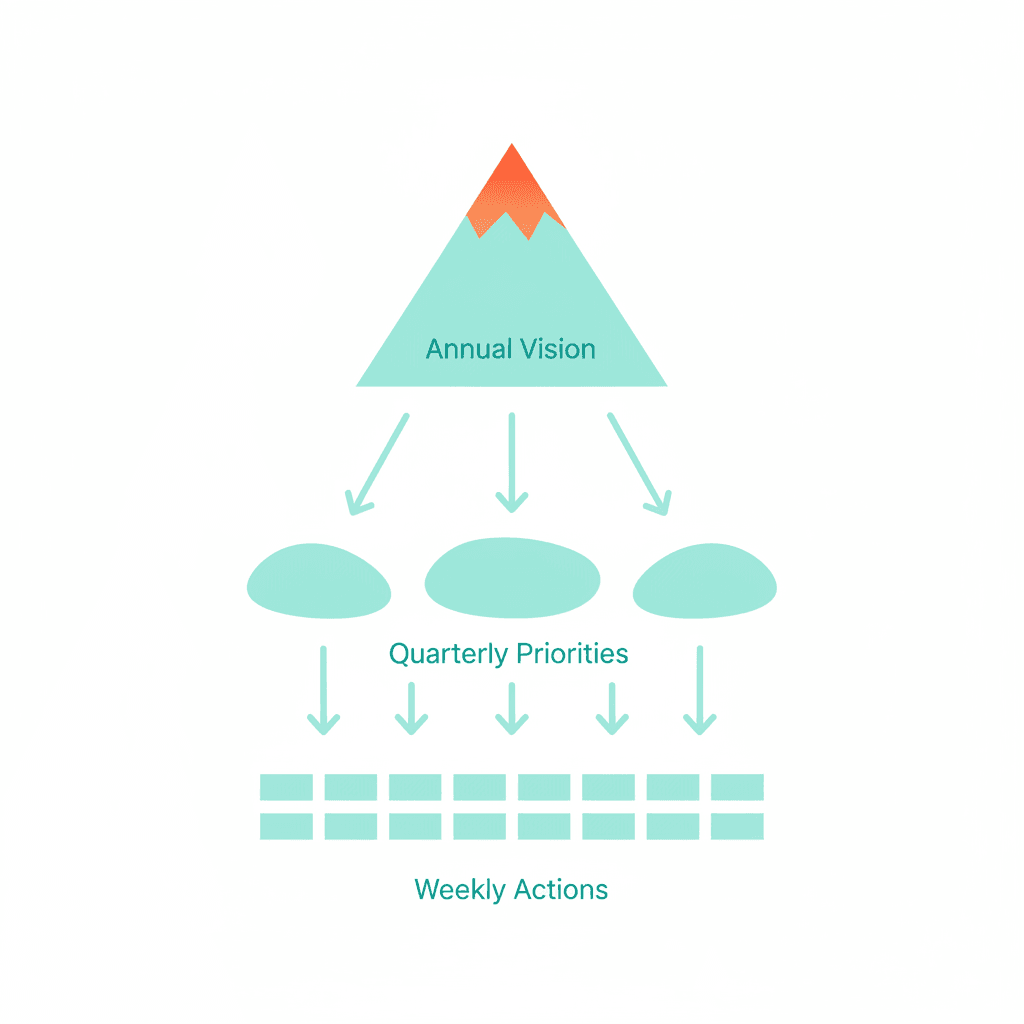
Goal setting for entrepreneurs is the practice of translating annual business targets into a three-level priority structure — annual goals, quarterly Rocks, and weekly Most Important Tasks (MITs) — so that weekly execution stays connected to strategy rather than being driven by the inbox. Without this structure, goals set in January become invisible by March, and Monday mornings fill themselves from whatever is loudest rather than whatever matters most.
Most founders are not short of ambition. They are short of a system that connects ambition to the first task on Monday morning. The framework below takes ninety minutes to set up and thirty minutes per week to maintain. It does not require a new tool, a consultant, or a planning offsite. It requires one annual goal, two or three quarterly commitments, and a weekly pass that takes ten minutes inside your existing weekly review.
Why entrepreneur goal setting breaks down
The corporate model — OKRs, balanced scorecards, quarterly business reviews — is designed for organisations with product managers who track metrics daily. For a founder running a five-person business, the overhead is disproportionate. The quarterly OKR ceremony takes longer than executing the priorities it is supposed to guide.
The other common failure is the opposite: goals set in isolation, never connected to any weekly structure. You write three annual targets in January, pin them somewhere, and check them in December to see how far short you fell. The overwhelmed business owner who fills every week from the inbox is not lacking goals — they lack a structure that puts the right priorities at the top of Monday morning before everything else arrives.
The fix is a three-level hierarchy that is light enough to maintain but strong enough to make the important work non-negotiable. This is the core of the productivity framework for entrepreneurs that Nerd Productivity teaches — plan from the annual goal down, execute from the weekly MIT up, and let the weekly review close the loop.
Level 1 — the annual goal
One primary business outcome for the year, defined as a single measurable number with a specific deadline. Revenue target, client count, product milestone — one, not five. Most entrepreneurs set five annual goals and achieve three partial versions of each. A single annual goal is easier to defend against distraction.
Write it in one sentence: “By 31 December 2026, [business name] will achieve [specific outcome].” Paste it at the top of your task manager. Add it to the CLAUDE.md context file in your Claude workspace, so it sits at the top of every session before anything else loads. When something asks for your attention, you ask one question: does this move the one number?
If you cannot write the goal as a single measurable sentence, that is the first thing to fix. “Grow the business” is not a goal. “Sign 12 retained clients at £2,000 per month by 31 December 2026” is a goal.
Level 2 — quarterly Rocks
A Rock is a ninety-day deliverable that, if completed, meaningfully advances the annual goal. The term comes from the time management principle made popular by Stephen Covey: put the big rocks in the jar first, or they never fit. In practice, a business running one annual goal sets two or three Rocks per quarter — never more than three, because Rocks are protected commitments, not a wish list.
Before you assign anything Rock status, run it through a three-question filter. First, does completing this deliverable move the annual number? If no, it is a useful task but not a Rock. Second, can it be finished in ninety days with the resources currently available? If no, it needs to be scoped down or deferred. Third, is there one named person — you or a delegated owner — who can be held accountable for it? If the answer is “the team generally,” it does not pass. The Rocks and MITs method has the full filtering protocol.
Rocks that fail the first question belong in the backlog, not on the Rock list. Backlog items are visible but not protected — they get worked on when Rock progress allows, not before. This is where most business owners accumulate “strategic” initiatives that never actually move: they are not Rocks, they are backlog items masquerading as priorities. The framework for prioritising tasks as a business owner covers this distinction in detail.
Level 3 — weekly Rocks and MITs
Each week, you pick one Rock per active project as that week’s non-negotiable commitment. This is the weekly Rock — the single deliverable that defines whether the week moved the business or was consumed by it. Below each weekly Rock, you set one MIT: the Most Important Task, the first concrete step that moves the Rock forward by Friday.
The MIT must be specific enough to time-block. “Work on the proposal” does not qualify. “Write sections 2 and 3 of the proposal — first draft only, two hours” qualifies. Time-blocking the MIT before anything else goes into Monday morning is the habit that makes the whole hierarchy executable. Without it, the Rock lives in a list and never reaches a calendar slot.
Everything else in the week fills around the MIT. Reactive work, client calls, admin — all of it fits into the hours that remain after the MIT is protected. This is not about eliminating reactive work. It is about ensuring that the work that matters most gets the best cognitive hours rather than the leftover ones.
The quarterly setup sequence
The first setup takes ninety minutes and needs to happen once per quarter. Write the annual goal in one sentence. List three to five candidate Rocks for the current quarter and run each through the three-question filter. Accept only those that pass all three. For each surviving Rock, write one MIT that could be completed this week to start momentum.
After the first setup, the quarterly Rock-setting takes thirty minutes at the start of each new quarter: review whether the previous Rock was completed, close or carry forward any unfinished work, set two to three new Rocks for the next ninety days. The weekly pass — naming the weekly Rock and MIT for each active project — takes ten minutes inside the existing weekly review for business owners.
This is the total overhead of running the system: ninety minutes once, thirty minutes per quarter, ten minutes per week. Every hour invested in the Rock structure saves multiple hours of mid-week priority confusion.
The two-decision rule for mid-week disruptions
A client emergency lands on Wednesday. Something breaks that needs handling today. The two-decision rule tells you what to do without having to rethink your entire priority structure each time.
First decision: is this a genuine Q1 emergency — something that, if left unhandled today, causes direct and immediate damage to the business? Most items that feel like Q1 emergencies are Q2 items with high emotional pressure. The Eisenhower Matrix for business owners helps with this classification. A client complaint that can wait until tomorrow is not Q1. A payment failure that blocks next month’s payroll is.
Second decision: if it is genuinely Q1, name the Rock or MIT it displaces and write that down. The displacement decision is as important as the urgency decision. If the same Rock gets displaced twice in a quarter, it is not a Rock — it is an aspiration. Either close it or move it to next quarter with a committed start date and a named owner. The accountability framework covers how to hold the displacement log as a review tool.
Claude as a goal clarity partner
Claude cannot set your annual goal, because it does not know which outcomes matter most for your business at this stage. What it can do is sharpen the goal you already have, stress-test the Rock list before you commit to it, and surface conflicts between your Rock list and the week’s commitments before they surface themselves on Thursday afternoon.
Add the annual goal and the current Rock list to your CLAUDE.md context file — the same file described in the broader productivity system for entrepreneurs. Every session, Claude sees the priority structure before it sees anything else. When a new request arrives in the session, you can ask: “Does this conflict with any of the current Rocks?” When you are drafting the next quarter’s Rocks, you can ask: “Check this Rock list against the three-question filter and flag any that fail question one or question two.”
Claude is most useful at the Rock-to-MIT translation step. Given a Rock, it will suggest a concrete first task for the week — one specific enough to time-block and narrow enough to complete in a single session. That is the translation most goal-setting systems skip.
Four common mistakes
Setting goals as descriptions, not outcomes. “Improve the marketing” is a description. “Generate 40 qualified leads per month by Q4” is an outcome. If the goal cannot be measured against a specific number and deadline, it cannot be used as a decision filter during the week.
Setting more than three Rocks. Five Rocks means four will stall. You will protect the one you care most about and neglect the others, generating guilt rather than progress. Three is the ceiling. If you have more than three genuine candidates, rank them and move the bottom ones to the backlog — they will be visible for next quarter.
Skipping the weekly Rock pass. If you do not name the week’s Rock on Monday, the week runs itself from the inbox. The Rock list only functions as a decision filter if you consult it before the week fills. This is the single habit that separates goal-setting from goal-writing.
Treating the goal list as a planning document rather than a decision filter. The annual goal and Rock list only matter if they change what you say yes and no to during the week. If the goal list does not affect which incoming requests you decline or defer, it is not functioning as a goal-setting system — it is a wishful document you revisit in December.
What changes after four weeks
After four weeks of running the three-level hierarchy, two things change. First, you spend less time deciding what to work on. The Rock list makes that decision before Monday arrives. The cognitive overhead of choosing between competing priorities drops, because the hierarchy already ranked them.
Second, you see which commitments are real and which are aspirations. The gap between the active Rock list and the Someday/Maybe pile is usually where growth is stalling — not from a lack of ideas, but from too many half-started initiatives without protected weekly time. Once the Rocks are named and the MIT is time-blocked, the real constraints become visible.
The Nerd Productivity System‘s free course covers the full Rocks, MITs, and weekly review structure — the same framework that drives the goal-setting hierarchy above. If you want to work through it applied to your own business, the free course is the right starting point. It covers all four phases — Capture, Process, Plan, and Do — with the goal-setting and Rock-setting sequence in the Plan module.
Start with the free NP System course at nerdproductivity.com/productivity-system.
