
There’s a particular kind of frustration that hits business owners around the six-month mark of a busy period. You’re working hard. The to-do list moves. But when you look up and ask what’s actually different, the answer isn’t always clear.
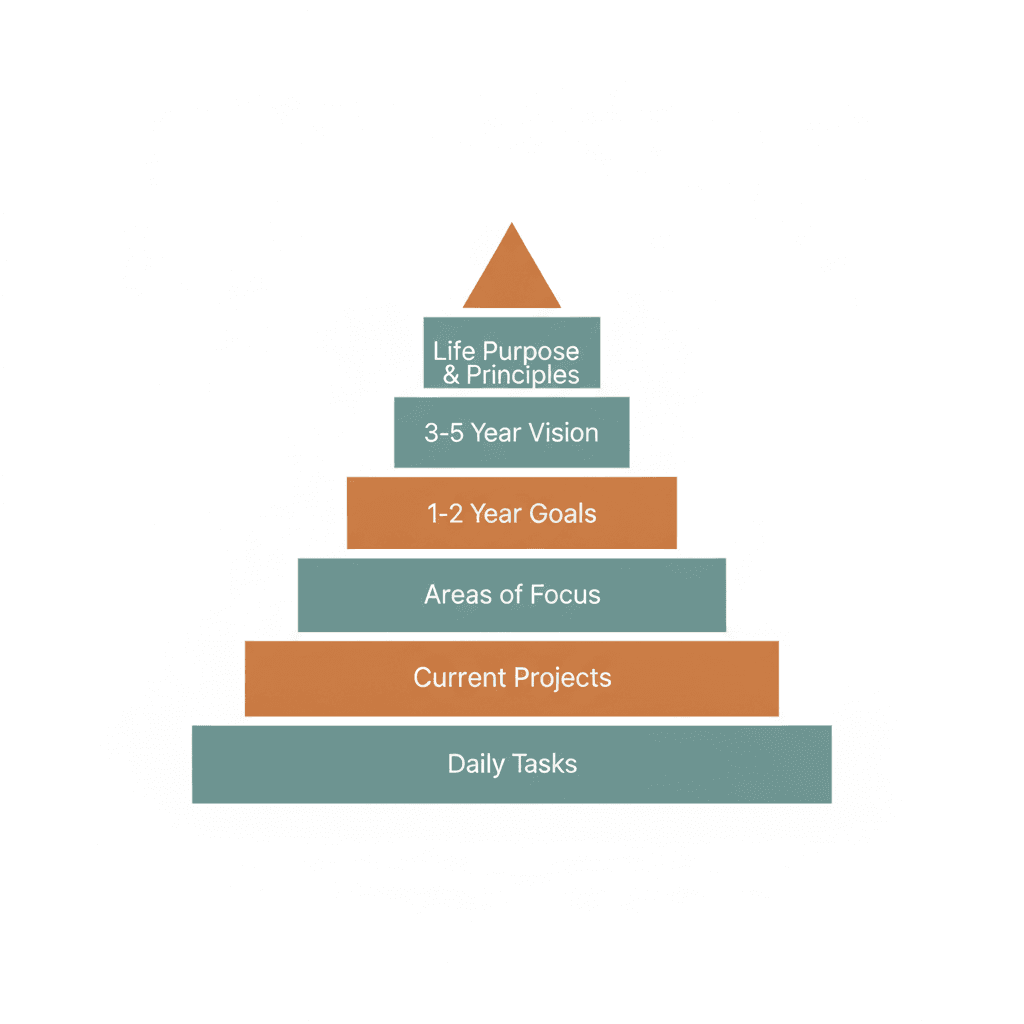
The GTD horizons of focus framework exists specifically for this situation. It’s a six-level model from David Allen’s Getting Things Done methodology that links what you’re doing today to what you’re building over the next five years.
Most people use GTD only at the bottom level — the next-actions list. The horizons of focus are what make the system genuinely strategic, not just a better way to manage email.
What Are the GTD Horizons of Focus?
David Allen describes the horizons as six altitudes, from the runway at ground level up to 50,000 feet. Each level gives you a different perspective on your work, and each needs to be reviewed on a different cadence.
The core idea is that your daily actions only make sense when they’re connected to something above them. Without that connection, you’re just busy.
The Six Levels, From the Ground Up
Horizon 0 — Current Next Actions (the Runway)
These are the physical, visible tasks in your system right now: the emails to write, the calls to make, the documents to review. This is the level most task management systems operate at, and most people spend all their time here.
The runway needs clearing daily. Without a next-actions system, everything else in the horizons model loses its landing strip.
Horizon 1 — Current Projects (10,000 Feet)
A project in GTD is any outcome that requires more than one action. Launching a product, hiring a team member, closing a deal — all of these are projects. They sit one level above your next actions, and each project should have at least one next action in your system at any given time.
The question at Horizon 1 is: do all my open projects have a clear next step? A GTD weekly review is the right cadence for keeping this level current.
Horizon 2 — Areas of Focus and Responsibility (20,000 Feet)
These are the roles and domains you’re responsible for maintaining, not completing. In a business, your areas of focus might include operations, team, finance, marketing, and client delivery. At home, they include health, relationships, and finances.
Areas of focus don’t get done — they get sustained. They’re the lens you use to check whether your projects list is balanced or lopsided. A week where all your projects sit in one area is a week where imbalance is visible before it becomes a problem.
Horizon 3 — Goals and Objectives (30,000 Feet)
This is the one- to two-year picture. What does success look like by the end of next year? What would have to be true for the business to be in genuinely different shape?
This level is where the Rocks methodology lives in the Nerd Productivity System. The Rocks and MITs method takes Horizon 3 and makes it concrete enough to act on: three to five outcomes per quarter that move the needle more than anything else.
Horizon 4 — Vision (40,000 Feet)
The three- to five-year picture. What does the business look like? What does your life look like? Who’s on the team, what’s the revenue, what markets are you in?
Most business owners visit this level quarterly at best. That’s fine — it doesn’t need daily attention. It does need to exist somewhere, because without a picture at 40,000 feet the goals at 30,000 feet tend to drift toward what’s easy rather than what matters.
Horizon 5 — Purpose and Principles (50,000 Feet)
Why are you doing any of this? What’s the business for, and what are the values that govern how you run it?
This level sounds abstract, but it does practical work. When you’re facing a difficult decision about a client, a hire, or a direction, Horizon 5 is the level that settles it. Business owners who’ve done this work tend to make decisions faster — not because they’re more decisive by temperament, but because the framework is already in place.
How to Use the Horizons in a Weekly Review
The review cadence matters as much as the framework itself. Allen’s recommendation is to work upward — clear the runway first, then check projects, then areas, then goals. In practice, most business owners integrate the first three horizons into a structured weekly review and visit the higher levels quarterly or annually.
The practical question at each level is the same: is anything out of balance, missing, or out of date? The review doesn’t have to take long when the system is current — the point is to look at each level deliberately, not to rebuild it from scratch each week.
If you’re overwhelmed as a business owner, the most common cause isn’t too many tasks — it’s that the tasks aren’t connected to anything above Horizon 0. You’re working from the runway with no flight plan.
The NP System Connection
The Nerd Productivity System’s Plan phase maps directly onto GTD’s middle horizons. The Eisenhower Matrix and Rocks sit at Horizon 3. Time blocking sits at Horizons 1 and 2, connecting projects to available capacity.
The reason the NP System works without constant re-planning is that the higher horizons are stable. Goals don’t change weekly. When you’ve done the Horizon 3 work once, the weekly review becomes a check, not a rebuild.
Claude is the tool that makes this level of system sustainable for a business owner running multiple projects. A well-structured context file — the approach explained in how to turn Claude into a project manager — holds the Horizon 2 and Horizon 3 context so you’re not reconstructing it in every session.
Getting Started With GTD Horizons
The simplest entry point is a single document with six sections, one per horizon. Don’t try to fill all of them in one sitting — start with the two you’re clearest on (usually current projects and current goals) and add the others as you review.
The free NP System course walks through all four phases of the system — Capture, Process, Plan, and Do — and includes the templates for each level. If you’re already doing a weekly review and want to make it strategic rather than just operational, that’s the right next step.
