
Running a small business while managing a full home life means your days are rarely your own. Client requests arrive at 8am. School pickup is at 3pm. The strategic project planned for Tuesday gets crowded out by Wednesday’s crisis. Most productivity advice ignores this context entirely — it assumes a quiet morning, a clean desk, and a calendar you control. Business owners rarely have any of those things consistently.
The system that works for a small business owner looks different from anything designed for a solo knowledge worker or a corporate executive. It has to hold the business and the life simultaneously. It has to run in thirty minutes of actual triage time, not three hours of journalling. And it has to survive the weeks when everything arrives at once.
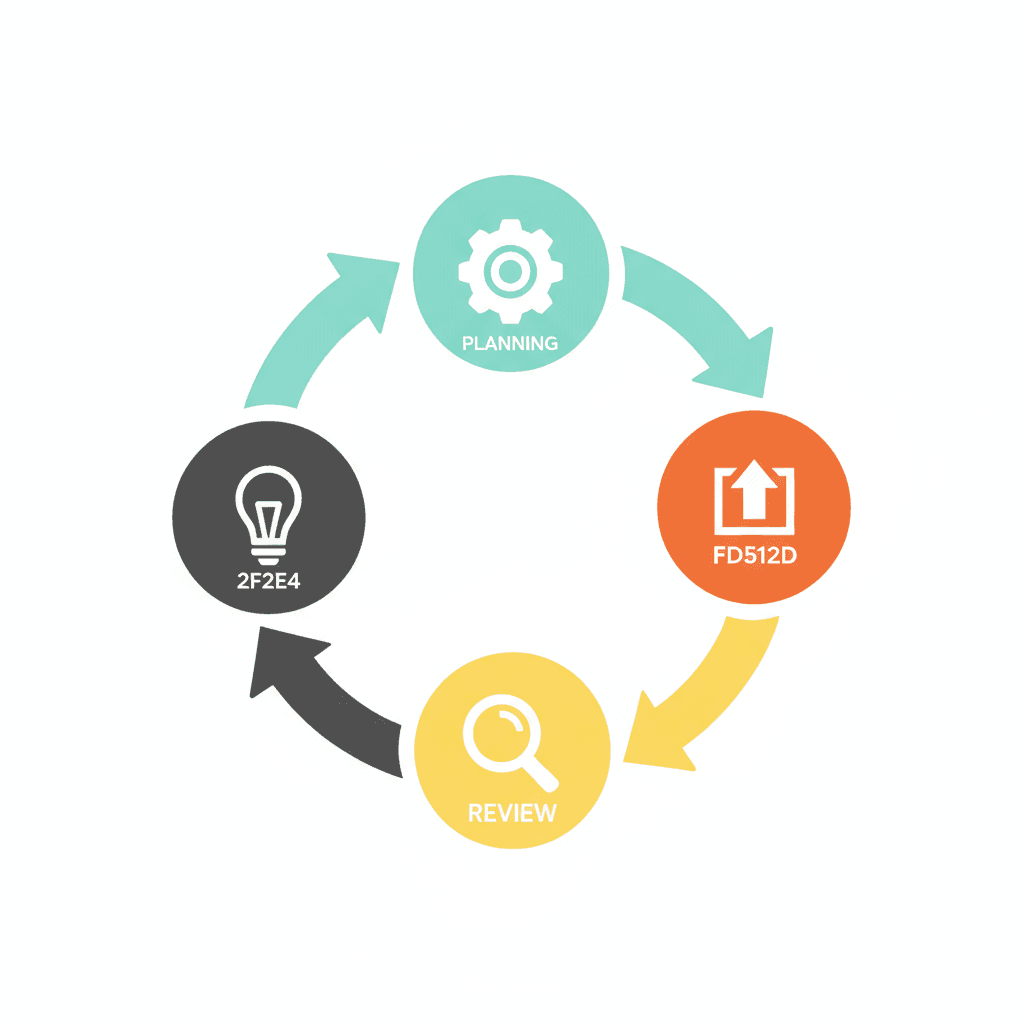
Over ten years of working with business owners across sectors — from PE-backed consumer brands to owner-operated service firms — I have watched the same pattern: ambitious systems that work for a few weeks and then collapse. The ones that stick share a structure. Four phases, each with a clear job to do: Capture, Process, Plan, Do.
Why Most Productivity Systems Fail Business Owners
The typical small business owner is not disorganised. They are managing more open loops than anyone’s working memory was designed to hold — client work, team requests, finance, business development, and the operational decisions that only they can make.
Most productivity advice addresses symptoms. A cluttered inbox, a missed deadline, a week that felt busy but produced little. The systems it offers are usually one of two types. The first is a capture-only tool — a task app, a sticky note habit, a voice memo system — that collects everything but never processes it. The pile grows. The second is a prioritisation framework that assumes you already know what matters most. It does not solve the problem of deciding.
What a small business owner actually needs is a closed loop. A system that captures every demand on their attention, processes those demands into decisions, plans around what matters most, and protects time for the work. The NP System runs that loop in four phases.
The Four-Phase Productivity System for Small Business Owners
The NP System has taken ten years to stabilise. It draws from Getting Things Done, Deep Work, and Covey’s time management model — adapted for people running their own business with a full home life alongside it. Each phase has one job. Together they close the loop.
Phase 1 — Capture
The first job is to get everything out of your head and into one place. Not several places — one.
Most business owners have tasks distributed across five different locations: their email inbox, a task app, a notebook, a WhatsApp thread with their team, and their own memory. Nothing closes. Open loops consume background attention all day, the way browser tabs slow down a computer that isn’t actively using them.
A brain dump clears this once. Set a timer for fifteen minutes and write down every open loop you can find — every project, commitment, task, and vague “I should get around to this” across work and life. Then pick one inbox and route everything there. Email works for most people. A single task app works for others. The channel matters less than the discipline of using only one.
The system breaks at every other phase if Capture is distributed. Pick one channel and route everything there first, before introducing any other element of the system.
Phase 2 — Process
Capture without processing is just a larger pile with better organisation.
Processing means making a decision about every item in the inbox, using the 5 Ds: Do (under two minutes, handle it now), Defer (it needs doing later — put it on a specific day, not “soon”), Delegate (someone else can handle it — send it now with a deadline and context), Drop (it does not need doing at all — delete it), or Diary (not actionable yet — park it with a review date).
There is no sixth option. The inbox does not close until every item has one of these five decisions.
For most business owners, ten to fifteen minutes of processing each morning is enough. The discipline is not in the method — it is in doing it every day, including the busy days, rather than saving it for a quieter week that never arrives. The most common mistake is treating Processing as optional when the inbox is overflowing. That is exactly when it matters most.
Phase 3 — Plan
Planning is where the system earns its keep for a small business owner.
Once a week — thirty minutes is enough — you review what is in the system. What deadlines are approaching? What projects have stalled? What commitments have you made that are not yet reflected anywhere? The weekly review catches these before they catch you.
From the review, you set three to five rocks for the week: the outcomes that matter most, regardless of what else comes in. Then each morning you pick two or three Most Important Tasks from that list and do those first — before email, before messages, before the requests that feel urgent but are not.
Business owners who skip the weekly review find themselves productive in the sense of constantly moving, but unable to point at the week’s actual output. The review is the difference between activity and progress. Thirty minutes on a Friday afternoon or Sunday evening changes how the entire following week runs.
Phase 4 — Do
Doing is the phase most productivity systems discuss at greatest length, and the phase where most of the advice is wrong for a small business context.
The standard recommendation is time-blocking your calendar — which is correct — but the typical implementation books every hour and leaves no buffer. The first disruption collapses the plan for the day. A business owner’s calendar needs structure, not rigidity.
The version that works for a small business owner protects deep work first: the two to three hour window of the day when your thinking is sharpest, reserved before anything else touches the calendar. Reactive work — email, messages, admin, team requests — gets batched into one or two defined windows rather than distributed across the day. Buffer time absorbs the unexpected without destroying the plan.
The 3-3-3 rule gives this structure a daily shape: three hours of deep work on the most important task, three shorter tasks that must happen today, and three maintenance items that keep the week functional. It is built around real limits, not aspiration — three hours is roughly the ceiling for sustained deep work, and three live tasks is about what working memory holds before it turns into juggling.
Where the AI Layer Fits
The NP System defines your contexts, your goals, and your constraints. That structure is precisely what makes AI genuinely useful for a business owner.
When you have a clear capture inbox, a set of weekly rocks, and defined time blocks, you can hand Claude a job rather than a question. “Based on this week’s plan and these three open projects, draft the client proposal due on Tuesday” works reliably. “Help me be more productive” does not — because there is nothing concrete for it to work with.
The system comes first. The AI layer accelerates the system. In that order, not the reverse.
Where to Start
The most common mistake is trying to install all four phases at once. The system stalls because it asks for too much change at one time.
Start with Capture. Pick one inbox and spend fifteen minutes on a brain dump. Run that single habit for one week before touching anything else.
Add Process in week two — ten minutes each morning to clear the inbox using the 5 Ds.
Add the weekly review in week three — thirty minutes to set rocks and catch anything that has slipped through.
Add Do last — time-blocking and daily Most Important Task selection — once the first three phases are running without conscious effort. Each phase takes about a week to stabilise. Four weeks to a working closed loop is a realistic timeline for a small business owner building a productivity system from scratch.
The System That Holds the Business and the Life
The small business owner’s productivity problem is not a shortage of methods. It is that the methods available were not designed for someone managing a business, a team, and a family simultaneously — often from the same desk, in the same afternoon.
The Capture-Process-Plan-Do loop addresses this directly. It is not a motivation system or a morning ritual. It is a decision-making infrastructure that keeps the right things moving even when the week does not go to plan. The system handles the open loops; you focus on the strategy.
The full NP System — all fifteen habits across the four phases, including the Claude integration layer — is available as a free online course. It covers all four phases in eleven modules, at your own pace. If you want to build the closed loop properly, start here: The NP System free course.
For further reading, see the guides on productivity coaching for business owners and time management for business owners.
